| For nearly half a century, Proposition 13 has served as California’s bedrock defense against unsustainable taxation and fiscal overreach. By capping property tax rates and establishing clear supermajority vote requirements for special taxes, voters created a stable framework designed to keep homeowners in their homes and ensure local governments live within their means.
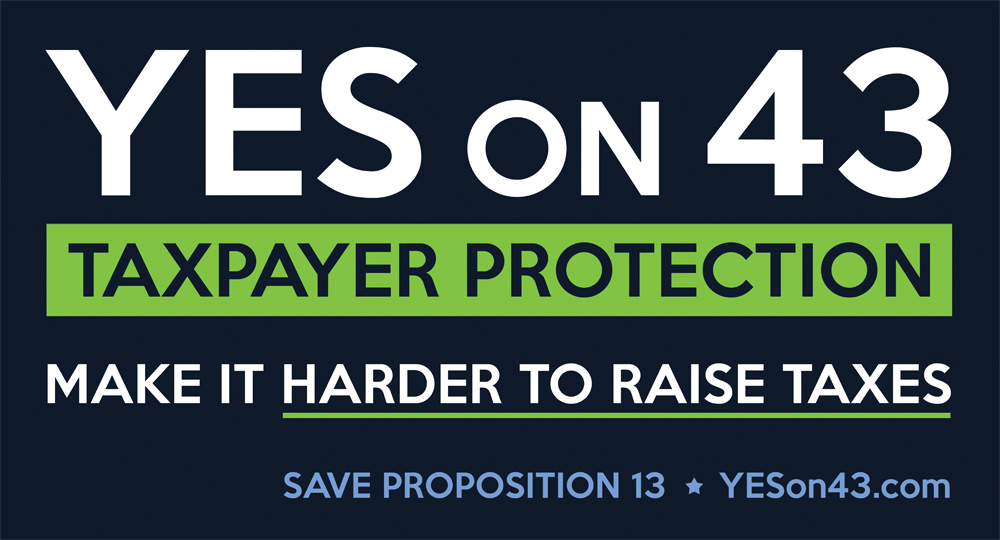
However, over the past decade, judicial rulings have eroded these core taxpayer protections. Unintended legal loopholes have compromised the constitutional guarantees voters passed in 1978, exposing property owners and local businesses across Ventura County to backdoor tax hikes. This November, voters can repair these constitutional safeguards by voting YES on Proposition 43 (The Local Taxpayer Protection Act).
The “Upland” Loophole and the Erosion of Supermajority Protections
The primary vulnerability facing California taxpayers stems from a 2017 California Supreme Court decision, California Cannabis Coalition v. City of Upland. Under the California Constitution, local special taxes—those earmarked for specific programs rather than general municipal funds—require a two-thirds (66.67%) voter approval threshold to pass.
The court’s ruling in Upland introduced a dangerous distinction: while tax hikes proposed by elected officials (such as a City Council or the Ventura County Board of Supervisors) still require a two-thirds vote, taxes placed on the ballot via citizen initiative might only require a simple majority (50% + 1).
Local governments and well-funded special interest groups quickly seized on this opening. By gathering signatures to place tax hikes on local ballots under the guise of “citizen initiatives,” tax proponents have routinely bypassed the constitutional two-thirds threshold. A tax that would fail under standard constitutional scrutiny can now pass easily through this procedural end-run.
Protecting Ventura County from Unconstitutional Taxes
The consequences of this loophole are not theoretical. In neighboring jurisdictions, measures like Los Angeles’s Measure ULA (The Mansion Tax)—a massive real estate transfer tax—were allowed to proceed under the lower 50% threshold despite violating the spirit and letter of state constitutional limits on property transfers.
Without constitutional correction, Ventura County communities face the exact same threat. Special interests can target municipal codes, school districts, and special districts with targeted tax increases, effectively undermining local economic stability while depriving taxpayers of their constitutional supermajority protections.
What Proposition 43 Restores
Proposition 43 establishes a uniform standard across California’s tax code:
- Equal Vote Standards: It clarifies that any special local tax increase proposed via citizen initiative must meet the exact same two-thirds voter threshold required of taxes proposed directly by local government bodies.
- Constitutional Integrity: It fortifies Proposition 13 by closing procedural gaps created by lower court interpretations, ensuring that property tax caps and transfer tax bans remain enforceable state standards.
- Fiscal Accountability: It prevents special interest groups from colluding with municipalities to push through localized tax burdens without broad-based community consensus.
Ventura County taxpayers deserve fairness, consistency, and constitutional certainty. A tax burden should not depend on whether a measure was placed on the ballot by a city council or through a loophole-exploiting petition drive.
To protect our communities, secure efficient government, and preserve Prop 13, the Ventura County Taxpayers Association urges a YES vote on Proposition 43. |