Guest commentary — Ventura County Taxpayers Association (VCTA) — Should you be concerned by the clear slowdown in labor force growth in Ventura County?

Editor’s note: Amigos805 welcomes guest columns, letters to the editor and other submissions from our readers. All opinions expressed in submitted material are those of the author and do not necessarily represent the viewpoint of Amigos805


Should You Be Concerned by the Clear Slowdown in Labor Force Growth in Ventura County?

The labor force represents all residents in the jurisdiction who voluntarily seek employment. Not all residents seek employment because they (1) are not of age, (2) are retired, (3) are not capable of working, or (4) simply choose not to participate in the workforce.

Growth of the labor force

The labor force typically grows in sync with the population. Workforce eligible participants in the population include all men and women age 16 and over with both a willingness and capacity to work.

Not all people 16 and over choose to formally work. Many will remain homemakers, family caretakers, are financially independent, or will be supported by means other than their own earnings.

The size of the labor force has moved in step with the population, until recently.


The 2020 pandemic created a behavioral change that reduced labor force growth despite slower albeit positive population growth.

Growth today is influenced by the aging population, changes in immigration policies, and a slower rate of hiring in the labor market.

The Baby Boomers Retire

The largest factor slowing the growth of the labor force is the rising retirement rate of the baby boom generation (born between 1946 and 1964 and representing anyone aged 62 to 80 years old today). Due to improved health and longevity, some boomers will continue to work beyond typical retirement age but many will not. Their departure from the labor force which was amplified by the onset of business lockdowns in 2020. Many two-worker households dropped to one as one left the workforce to become caretakers for sick family members and/or to home school their children.

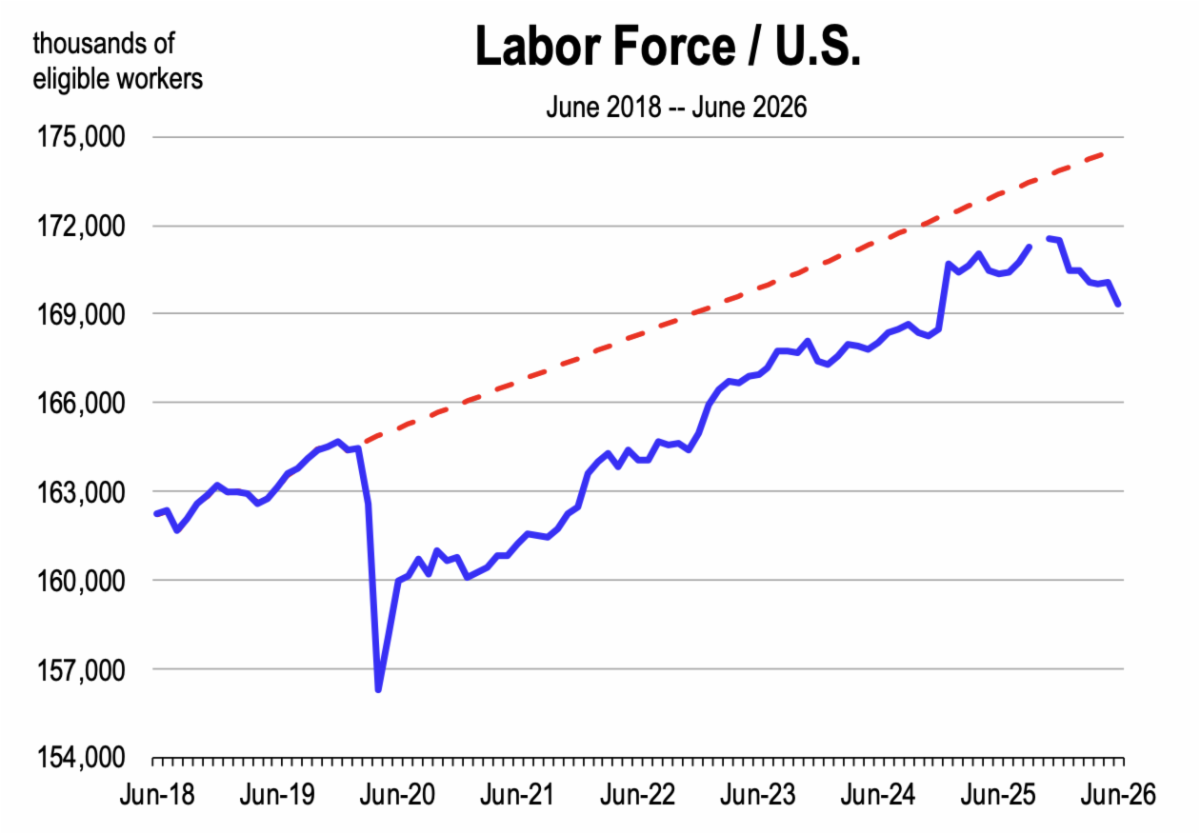
The labor force began to resume a normal growth trend by 2022 but that growth rate is much lower than the pre-pandemic rate. Consequently, today the labor force is much lower than the pre-pandemic trend line suggests. This is the red line in the chart.

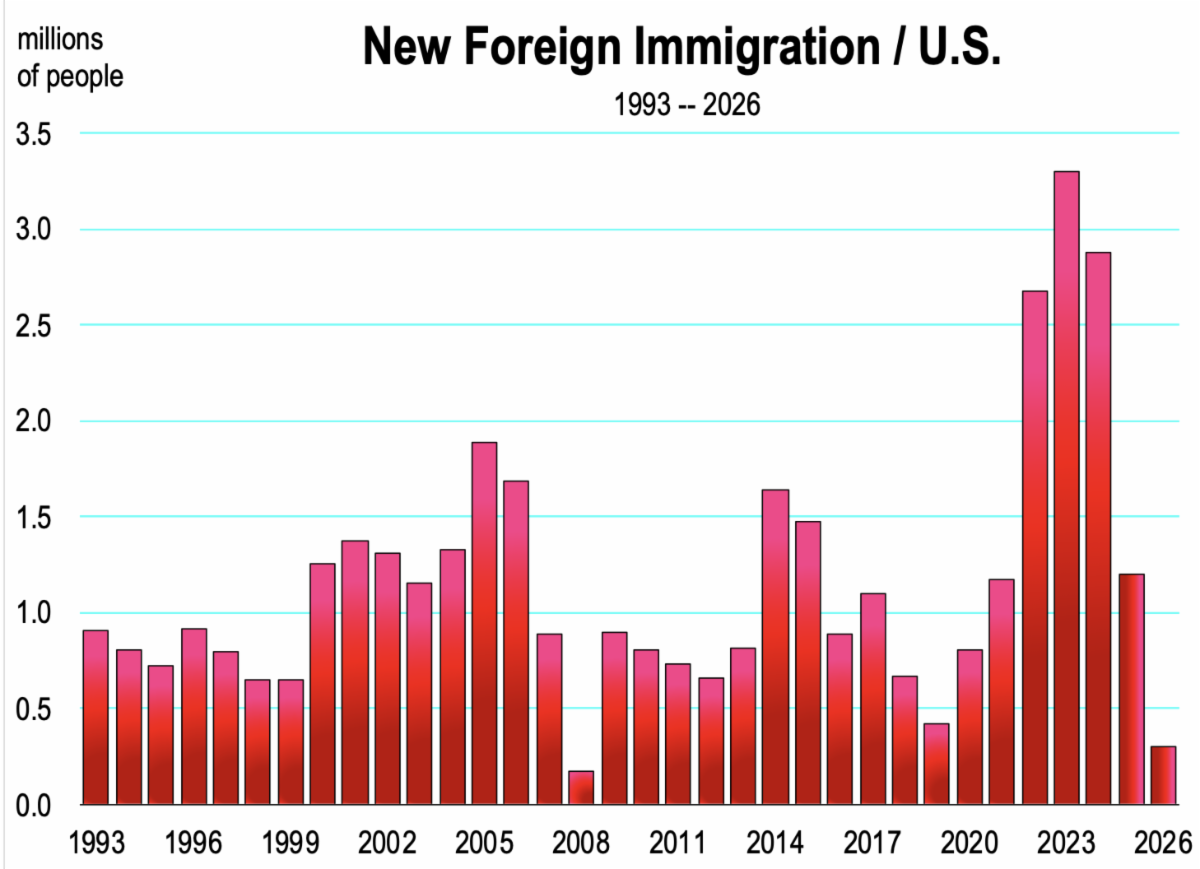
The lower labor force today (6 million off trend) is now being exacerbated by new immigration policy since January 2025 that has reduced foreign in-migration by 85 percent.

The Trump Administration Cracks Down

The immigration explosion that characterized the southern border of the United States in 2022, 2023 and 2024 was abruptly ended by executive order on Trump’s first day of office. An estimated 10 million net migrants entered the U.S. through southern U.S. border stations under the Biden Administration, an average of 2.5 million per year. That number has now dwindled to an estimated 321,000 in 2026.

Currently, the estimates of net international migration are trending toward negative net migration. If those trends continue, it would be the first time the United States has lost international migrants in more than 50 years.

This remains a principal reason for very low unemployment rates nationwide, and why despite very low rates of employment growth, there is no visible trauma in the labor markets.

California

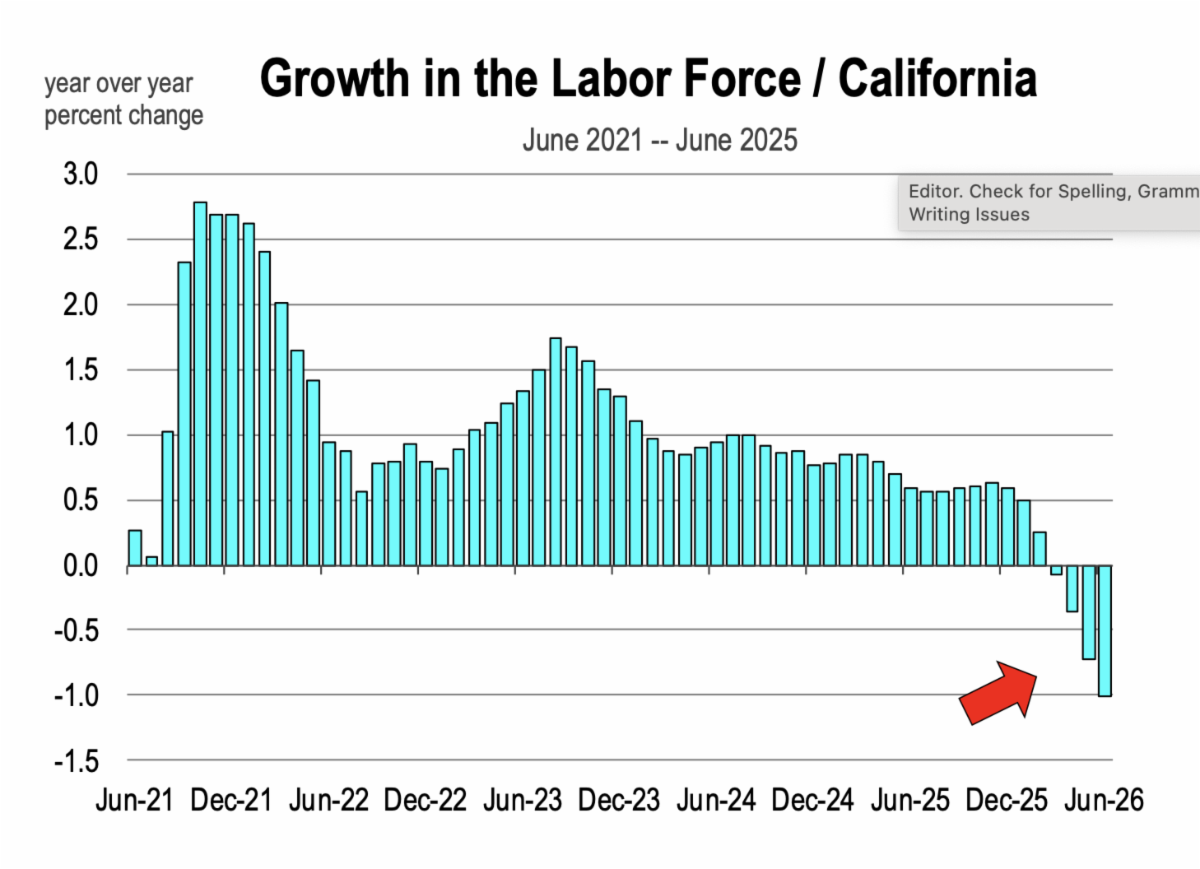
Labor force growth has now turned even lower in California, down more than 1.0 percent year over year in June. Declining population and labor force is largely the result of residents leaving California for more affordable states, and the meaningful reduction in net foreign immigration relocating into California.

Ventura County
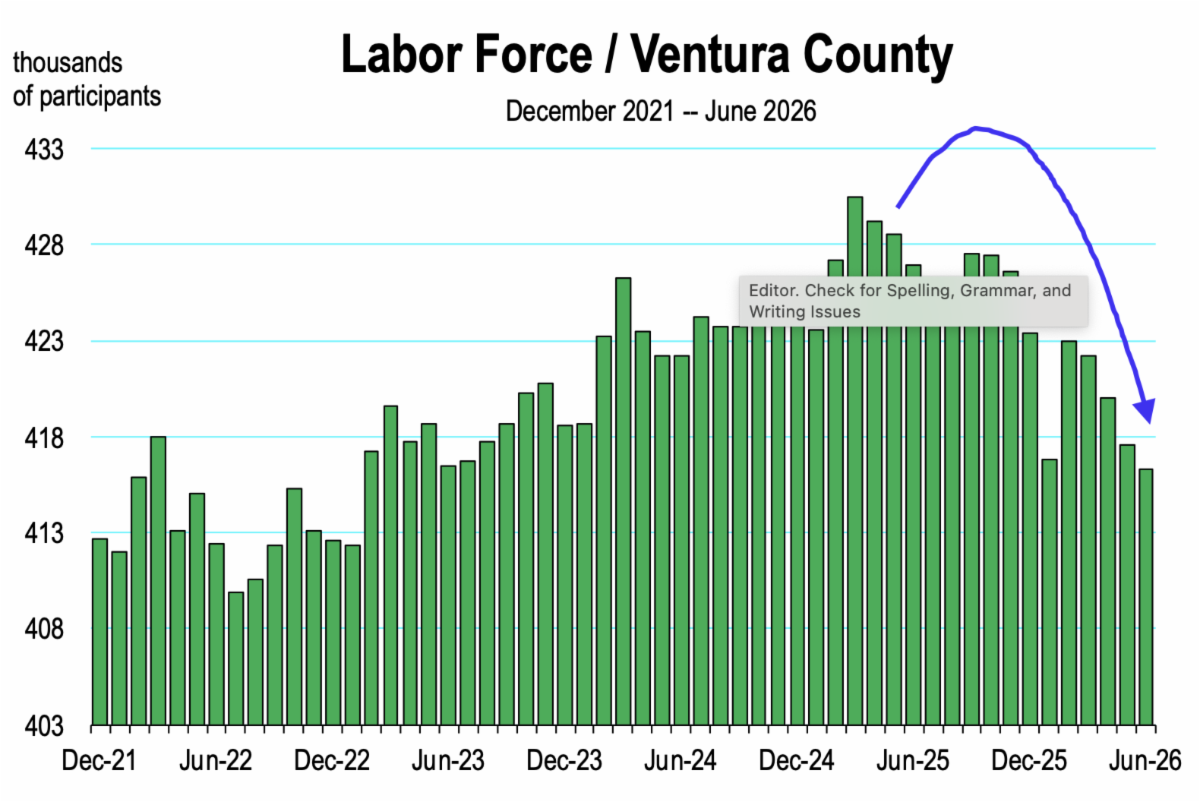
The labor force in Ventura County has been shrinking since March of 2024, in parallel to the total population. There are now fewer people either working or looking for work in the county.

The pool of workers from which existing or prospective firms relocating into the county can draw from is smaller. Workers will need to be relocated into Ventura County to fill open positions or they will commute.

To date however, job creation in Ventura County has been negligible. In short, the contracting labor force is falling faster than the contracting workforce, causing the unemployment rate to decline.

So, while Ventura County does not show any signs of escalating unemployment, the lack of available workers represents a serious impediment for firms wanting to or needing to hire.

Implications


The U.S. continues to grow in terms of total employment and population, though the rates of growth have slowed to a crawl. Nevertheless, there are more households creating income and providing revenues to federal, state, and local governments through taxation.

In California, population and the labor force are in decline. Ditto Ventura County and many coastal counties in the state. Declining population and labor force don’t automatically lead to collapse, but they do mean the region must work harder to avoid slower growth, fiscal strain and reduced services over time.

A declining population and shrinking labor force can be offset by immigration or big productivity gains.

The labor force is the main input into production; when it stops growing or shrinks, it mechanically reduces the economy’s capacity to produce goods and/or services.

Fewer workers can create staffing gaps in key sectors like healthcare, construction, and services. This leads to rising wages as firms compete harder for talent.

With fewer workers paying taxes and more retirees drawing pensions and using healthcare, governments face shrinking tax bases and rising age?related spending, which can lead to higher tax rates or cuts to services.

Regions with sustained population and workforce loss may see school closures, reduced healthcare access, and underused infrastructure, thus making it harder to attract businesses or new residents. This could ultimately lead to a downward spiral.

Possible Responses

Develop incentives to keep older workers in the labor force longer.

Attract migrants to replenish the working-age population. However, the problem here is housing. So more aggressive housing policies must be pursued. This will be very difficult with SOAR in Ventura County and the California Environmental Quality Act determining development in California.

Encourage automation and boost productivity with broader implementation of AI systems. Fewer workers will be needed and existing workers will earn higher rates of remuneration.

Starup companies will be limited since workers will be scarce. Consequently, housing policies must adapt to at least a reduced level of demand for new migrant workers.

Written by Dr. Mark Schniepp

Dr. Mark Schniepp is a VCTF Board Member and Economic Advisor. Dr. Schniepp is currently Director of the California Economic Forecast in Santa Barbara. The Company prepares forecasts and commentary on the regional economies of California.

About the Ventura County Taxpayers Foundation

The Ventura County Taxpayer’s Foundation (VCTF) is a non-partisan 501(C)(3) organization emphasizing issues that affect Ventura County. Empowering Taxpayers, Building Trust, and Safeguarding Resources.

Ventura County Taxpayers Foundation

PO Box 3878

Ventura, CA 93006

www.vctax.org

VCTF | vctax.org
Linkedin  Facebook  Twitter