
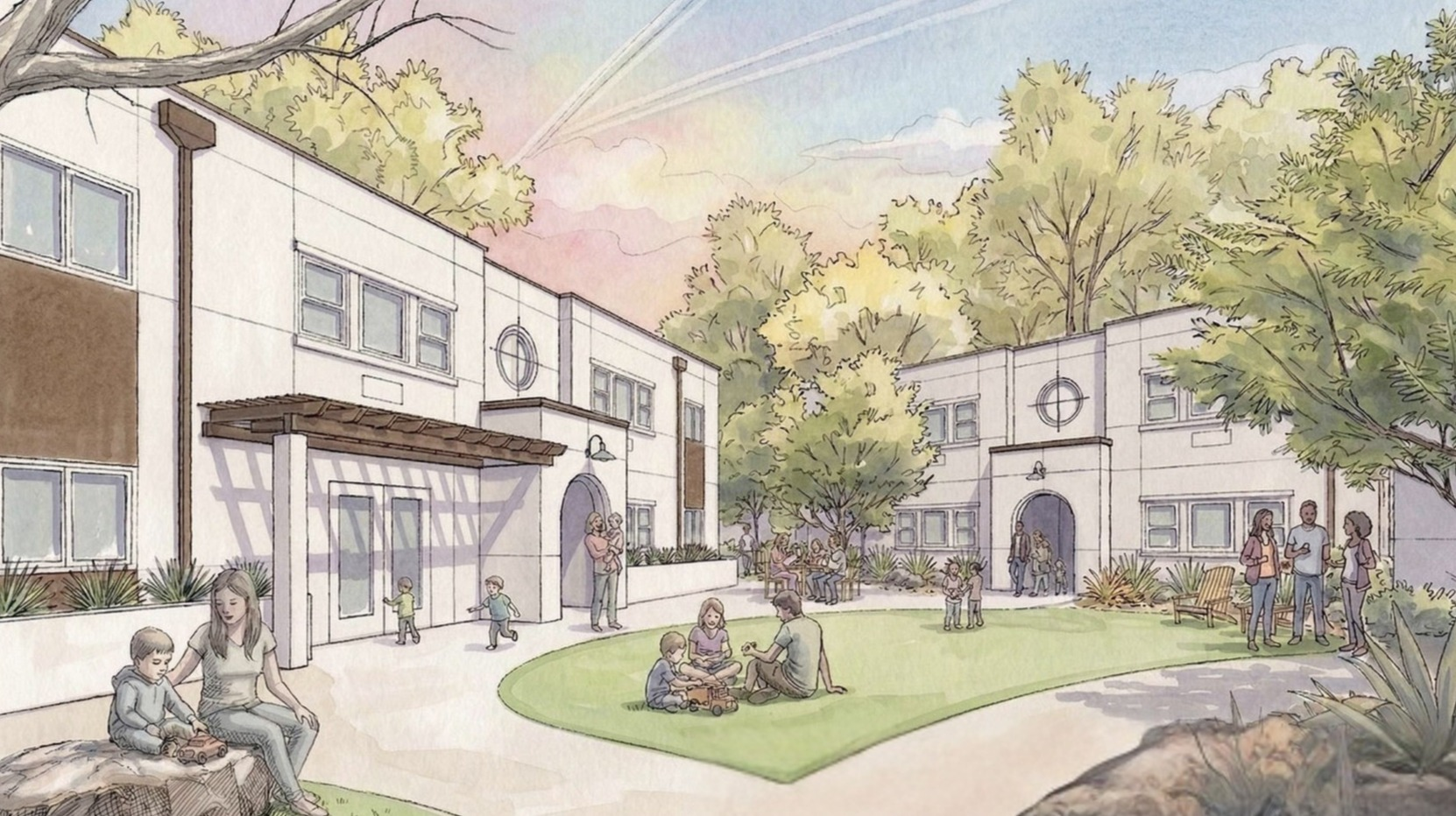
Image courtesy of the County of Santa Barbara.
Grant announced by Governor Newsom will fund New Family Village for Homeless Families in Santa Barbara County
OXNARD — California Governor Gavin Newsom recently announced the award of just over $11.7 million from the State’s Homekey+ program to the County of Santa Barbara, in partnership with DignityMoves, to support the development of a new housing community dedicated to families experiencing homelessness. $9,000,000 will fund construction of the village, with $2,000,000 funding wraparound services. DignityMoves has also raised $5,000,000 for construction and will raise an additional $2,000,000 for services.
The new “Family Village” will include 30 units designed specifically to serve families with children, providing a safe, stable environment alongside supportive services aimed at helping residents transition into permanent housing. The Family Village is proposed for development on County-owned land currently used as an overflow parking lot within the County’s Calle Real campus in the eastern Goleta Valley. This project comes at a critical time, as Santa Barbara County has the highest rate of child poverty in California.
“At its core, this project is about kids – this housing will help keep families together, give parents the support they need, and provides kid with the stability that they deserve. Through our partnership with DignityMoves, we are once again delivering high-quality housing that can be built quickly and start changing lives right away.” said County Supervisor Laura Capps.
DignityMoves, a nonprofit organization specializing in the rapid development of interim and permanent supportive housing communities, will lead the design and construction of the village. Known for its innovative approach, DignityMoves builds private, dignified units that can be delivered faster and more cost-effectively than traditional affordable housing, while still providing essential on-site services.
“We are honored to continue our partnership with Santa Barbara County to bring urgently needed housing to families,” said Elizabeth Funk, DignityMoves Founder and CEO. “This Family Village will offer a foundation for stability, healing, and a pathway forward.”
The new Family Village builds on DignityMoves’ growing footprint in Santa Barbara County, where three successful interim housing communities have been developed on County of Santa Barbara land:
· Santa Barbara Street Village: 34 units, serving unhoused individuals and couples in the downtown Santa Barbara area.
· Hope Village in Santa Maria: 92 units with the capacity to serve up to 113 residents, including transitional-age youth, veterans, and individuals needing medical recuperative care in the Santa Maria area.
· La Posada in Unincorporated South Santa Barbara County: 84 units, serving individuals exiting encampments in the area with on-site access to mental and physical health care.
Together, these communities have provided hundreds of people with safe shelter, access to services, and a pathway to permanent housing, further reinforcing a proven model for addressing homelessness at scale.
A community informational session will be held on Wednesday, July 8, from 6 to 7:30 p.m. at the Santa Barbara County Education Office Auditorium, 4400 Cathedral Oaks Rd., Santa Barbara. Community members will have an opportunity to learn more about the Family Village project, including preliminary construction timelines and site details.
About the County of Santa Barbara
The County of Santa Barbara provides a wide range of essential public services to support the health, safety, and well-being of its residents, including public safety, health and human services, infrastructure, and environmental stewardship. Governed by an elected five-member Board of Supervisors, the County delivers these services through 22 departments and more than 4,700 employees dedicated to serving the community.
About DignityMoves
DignityMoves is a nonprofit organization dedicated to ending unsheltered homelessness by building interim supportive housing communities quickly and cost-effectively. Its model emphasizes dignity, privacy, and access to services, helping residents stabilize and transition to permanent housing.
iSource: California Poverty Measure (CPM), averaged across 2021-2023, as reported by the Public Policy Institute of California in 2025 at https://www.ppic.org/interactive/california-poverty-by-county-and-legislative-district/