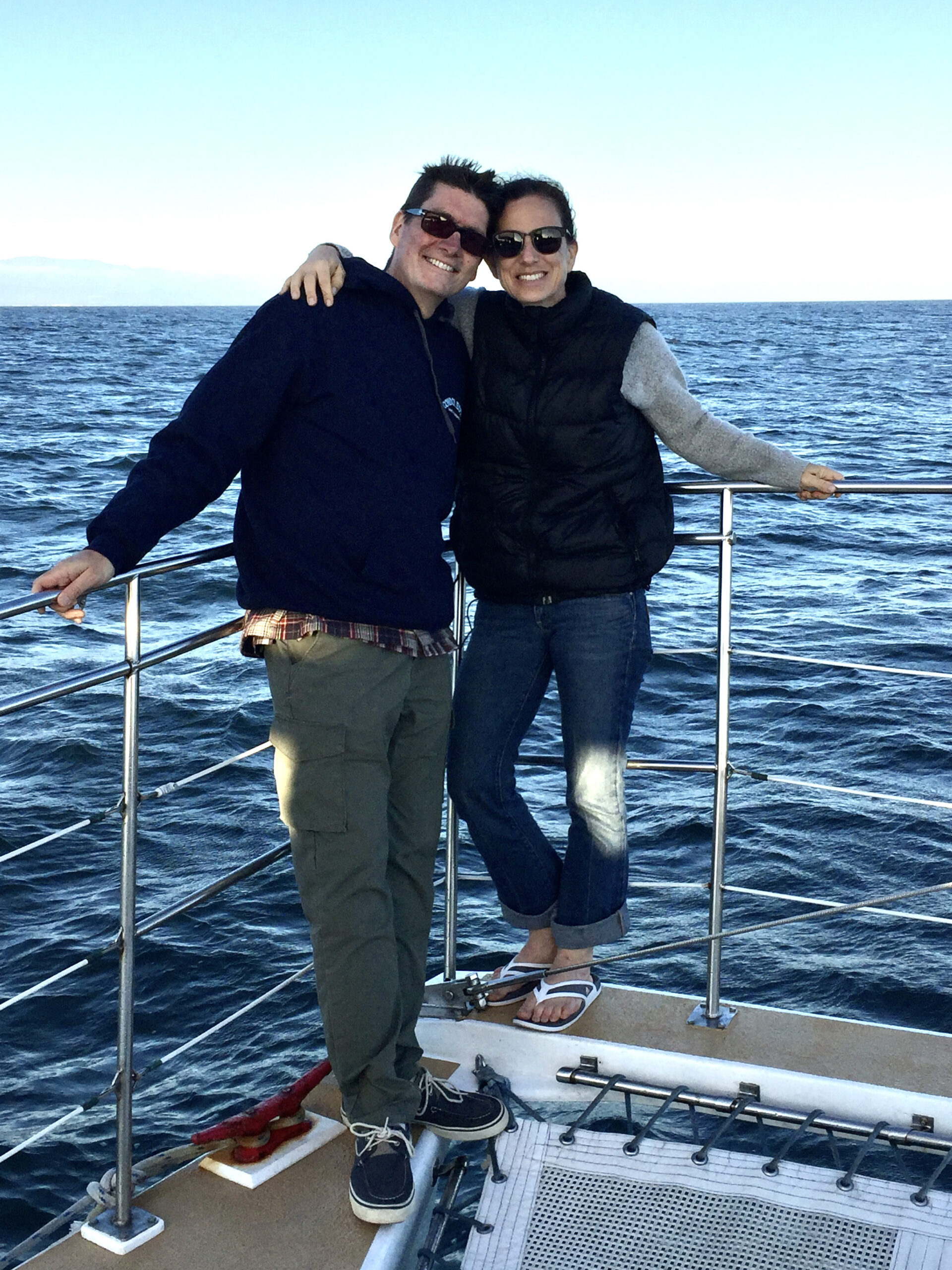
Owen and Laurie Bailey on the Dolphin sunset cruise in Santa Barbara in the summer of 2019. Photo courtesy of Hospice of Santa Barbara.
SANTA BARBARA — Owen Bailey met Laurie in December 1989 when she was 22 years old and was beginning the MFA theater program at the University of Connecticut. Owen was a senior. Together, they left after a year to work at a small regional theater near Portsmouth, New Hampshire, producing a play each month. It was a bohemian, romantic life filled with creativity, ambition, friendship, and just enough macaroni and cheese to sustain two young actors chasing their dreams.
Their shared passion for storytelling eventually took them to New York City, London, and finally Los Angeles, where Owen discovered his true calling as an environmental advocate. Laurie moved behind the camera and built a career in photography. Together they raised two children, Ben and Nicola, while balancing careers, family life, and a shared desire to make a positive impact on the world.
In 2013, Owen accepted the role of Executive Director of the Environmental Defense Center in Santa Barbara. The family embraced life on the Central Coast, spending weekends exploring Elwood Mesa, hiking local trails, and enjoying the beaches Owen loved. It was a busy, joyful, and deeply fulfilling chapter of their lives.
Everything changed in January 2017 when a lump in Owen’s neck led to a cancer diagnosis. Specialists at UCLA assured them the disease was treatable; a “bump in the road.” Owen endured a difficult surgery followed by intensive radiation treatments. He lost nearly thirty pounds and struggled to eat or swallow for weeks, but he persevered. By December 2017, he was declared cancer-free.
Then, in May 2019, a routine PET scan revealed metastatic cancer in his lungs.
The diagnosis shattered the future Owen and Laurie had spent decades building together. Their children were only nine and thirteen years old. Overnight, every assumption about the future was replaced by uncertainty. Laurie found herself awake in the middle of the night researching clinical trials and survival statistics, searching desperately for hope. The prognosis was sobering: metastatic head and neck cancer was considered incurable, and average survival rates were often measured in months rather than years.
Two things ultimately helped the family navigate that terrifying period: finding Dr. Ezra Cohen at Moores Cancer Center in San Diego and connecting with Hospice of Santa Barbara (HSB).
Like many people, Owen and Laurie initially associated hospice solely with end-of-life care. In reality, they discovered that HSB’s Children and Family Services program provides free professional support, counseling, education, and coping tools for children, teens, and families facing serious illness, death, and grief.
Their first meetings with HSB focused on practical and emotional needs they had never imagined confronting, including advance care planning and how to talk with their children about a terminal diagnosis. HSB helped them prepare for the difficult conversations while offering counseling and resources for the entire family.
Nationally, one in five children will experience the death of someone close to them by age eighteen, and one in twenty will experience the death of one or both parents before reaching adulthood. While illness, death, and grief are universal parts of life, they can become overwhelming and even paralyzing without professional support. For children and teens, unresolved grief is strongly linked to depression, anxiety, post-traumatic stress, and other emotional and behavioral challenges. HSB’s Children and Family Services program exists to ensure families do not have to navigate these experiences alone.
Just as importantly, HSB helped Owen and Laurie reframe their experience. Rather than allowing cancer to define every aspect of their lives, they learned how to continue creating meaningful moments and positive memories together. HSB showed them that acknowledging the reality of a terminal diagnosis did not mean surrendering hope, joy, or purpose—hope simply took on a different form.
As treatments progressed and multiple clinical trials failed, the family faced increasingly difficult questions. Would another treatment work? How much time remained? What should they tell the children? How would they manage financially? Then, as the COVID-19 pandemic began, those fears were compounded by global uncertainty. Owen’s lungs were already compromised, and the family suddenly found themselves isolated while facing both a public health crisis and a terminal illness.
When in-person support became impossible, HSB continued meeting with the family virtually. During this time, Owen and Laurie were paired with counselor Marilyn Goldman.
The weekly sessions became a lifeline. Some were filled with fear and tears, others with laughter and honest conversation about life, illness, and parenting through uncertainty. Marilyn helped them stay grounded in the present, offering tools to resist being consumed by “what if” thinking and to remain connected to one another as a family.
One of the greatest gifts Laurie later recognized was that HSB helped them continue living fully while facing the reality of Owen’s illness. They learned they did not need to deny what was happening, but they also did not need to stop making memories.
When Owen required ten days of radiation treatment in San Diego during lockdown, the family rented a modest Airbnb and called it their “Radiation Vacation.” Between treatments and online school, they explored beaches, shared meals, and created lasting family memories. Their children still associate San Diego not with illness, but with time spent together as a family.
The same approach carried them through frequent trips for clinical trial infusions. Some of Laurie’s most vivid memories are unexpectedly simple: sitting in a car in an Escondido parking lot eating takeout from a small Himalayan restaurant, talking about life, fear, hope, and family. Those moments were only possible because HSB helped them stay present rather than consumed by anxiety about the future.
HSB’s support extended through the entire family including their two kids. Through the Children and Family Services program, their daughter participated in approximately six months of individual counseling, gaining a safe and confidential space to express fear, sadness, anger, and confusion without judgment. At a time when many children struggle to name or process such emotions, she was given tools to understand and navigate her experience.
She also received support through HSB’s school-based program during her junior year at Dos Pueblos High School, helping her remain supported through both academic and emotional challenges. The impact of that care continues today: their son now volunteers with the Kasem program at the University of California, Santa Barbara, a student-led nonprofit that supports children affected by a parent with cancer.
By spring 2022, the focus shifted toward ensuring Owen’s final wishes were honored. He did not want to die in a hospital. Laurie wanted to remain by his side. With the guidance of HSB, the family navigated these deeply difficult conversations and decisions together.
Owen died at home, surrounded by Laurie, his children, his parents, and the life he had built. His final days unfolded in the home he loved, surrounded by his garden, peach trees, butterflies, birds, and the people who mattered most to him. Though heartbreaking, those final days were also marked by love, connection, and a sense of peace.
HSB helped the family understand that a meaningful death, like a meaningful life, deserves intention, care, and support.
After Owen’s death, HSB continued to walk alongside Laurie and the children through grief. Laurie feared how they would survive the loss, but through counseling and support, she learned that grief cannot be rushed or avoided—it must be lived through, with patience and compassion.
Marilyn helped the family understand that each person grieves differently, and that there is no single right way to mourn. They created space for sadness, healing, and resilience without judgment or expectation.
Nearly four years after Owen’s passing, their son is preparing to graduate from college and their daughter from high school. Both are thriving, while continuing to carry their father’s love and influence with them. They miss him every day, but they also carry forward the memories of a life deeply lived together.
For Laurie, grief still arrives in waves. Some days and months remain difficult. But she no longer fears those moments. Instead, she recognizes them as evidence of enduring love and a life shared for thirty-three years.
When she reflects those final years, Laurie does not think only of illness. She remembers presence—beach walks, family trips, conversations in parking lots, laughter in hard moments, and the memories they chose to keep creating together. Because of HSB, the story of those years is not defined solely by loss, but by connection, resilience, and love.
For that, Laurie remains profoundly and eternally grateful.
Hospice of Santa Barbara—to hear more voices and stories and to support the free services of Hospice of Santa Barbara, join us for this year’s Heroes of Hospice of Santa Barbara luncheon, September 27th, at 11:30 am at the Hilton Beachside Resort. For tickets, visit: www.hospiceofsb.org/heroes. HSB provides professional counseling, support groups, and patient care services free of charge to individuals and families who are grieving the death of a loved one or experiencing the impact of a life-threatening illness. Hospice of Santa Barbara also provides counseling in our offices and on 17 local elementary, junior high, and high school campuses to children and teens who are grieving the loss of a loved one.