|
Jobs, Housing, Population:
The Triple Drag on Ventura’s Future
|
|
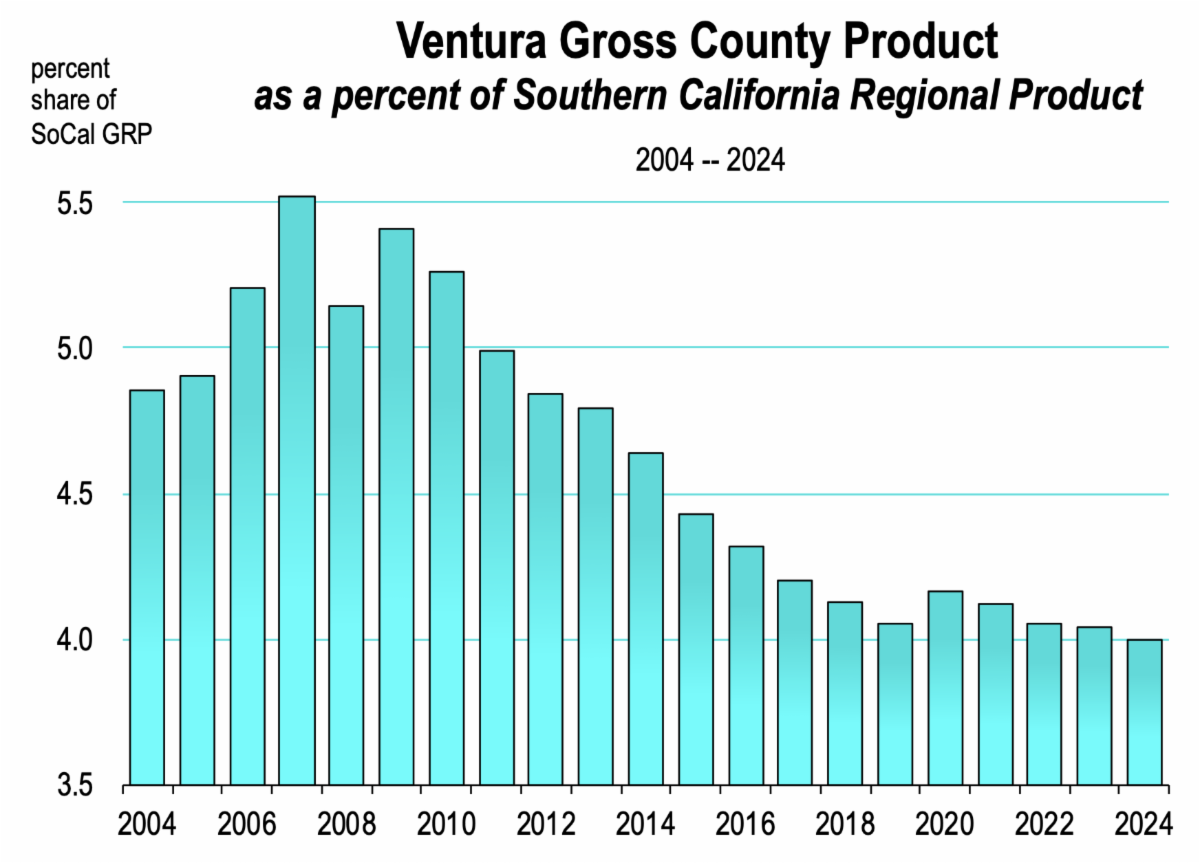
| Economic growth is positive in the County but there is concern because the general economy is contributing less to the broader Southern California economy. Over the last 15 years, Ventura County’s contribution to gross regional economic activity for the aggregate of Los Angeles, Orange, Riverside and San Bernardino Counties has been in a continuous decline.
The percentage of gross county product contributed by Ventura County as a percent of total Southern California gross product has declined from 5.5 percent in 2007 to 4.0 percent in 2024. The rate of growth remains positive, but it has consistently lagged the aggregate growth of the other four counties.
This is largely due to much lower employment and population growth, and less new development of residential and non-residential structures. SOAR has been a principal impediment to growth in the region. It has largely limited organic growth and discouraged new in-migrating business growth. |
|
|
Agriculture
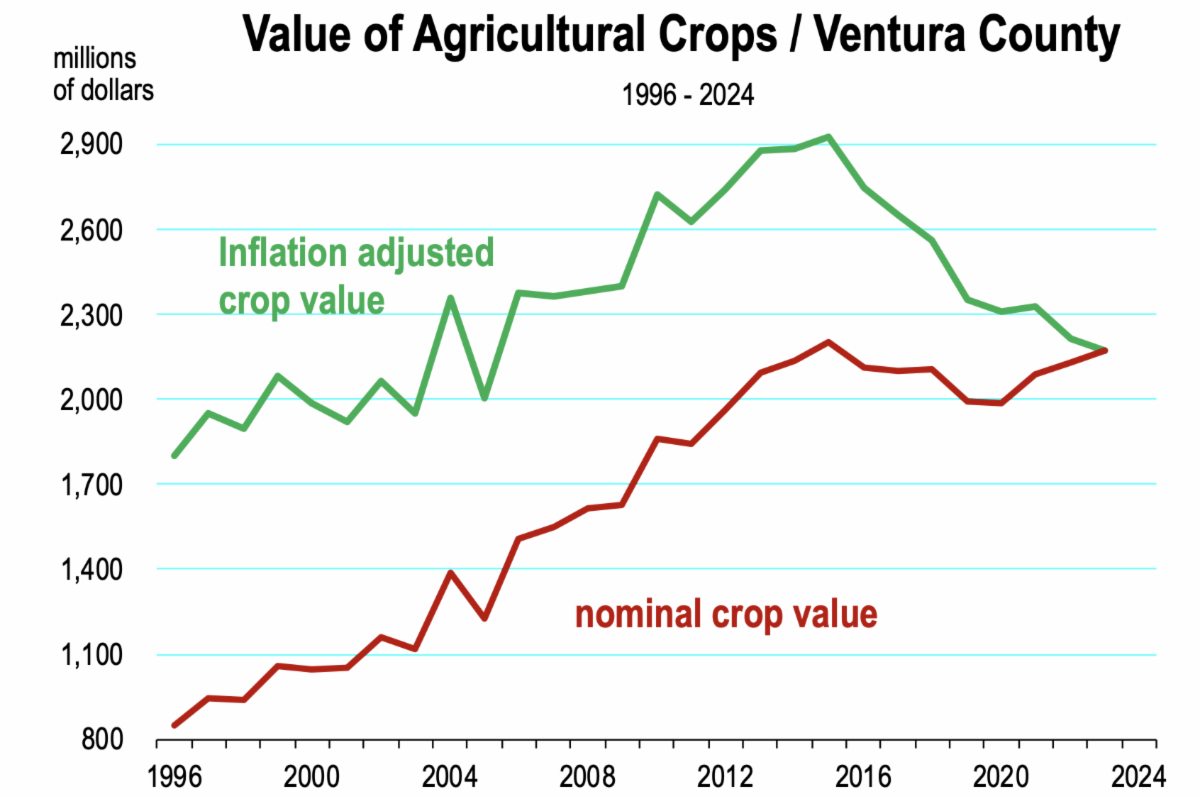
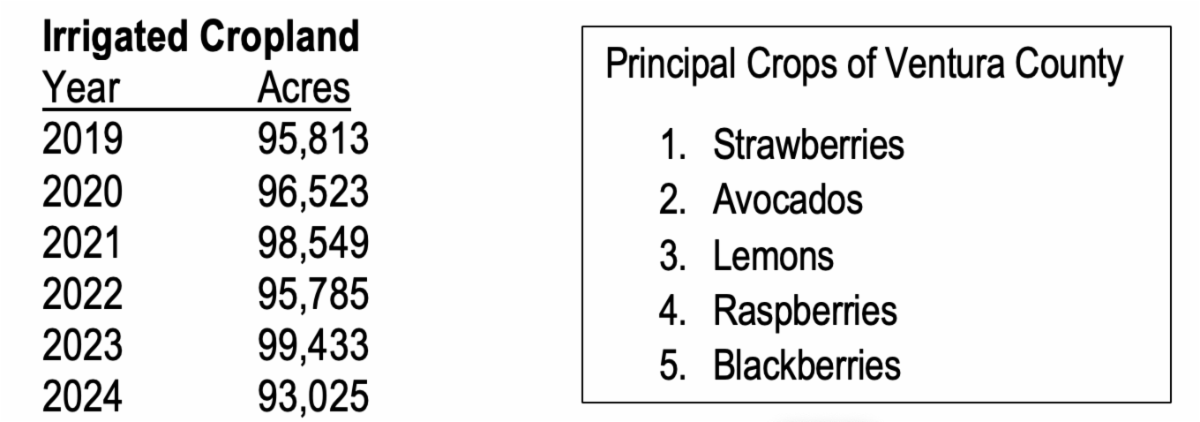
The principal crop is strawberries accounting for roughly a third of all agricultural sales. The County produces 22 percent of all strawberries grown in California, ranking it third behind Monterey and Santa Barbara Counties. Crop sales have remained relative flat over the last 10 years in Ventura County. Adjusted for inflation, sales have steadily declined since 2015, meaning general overall production has been falling. |
|
| California ranks first in the nation for farm production. It is a leading producer of a wide variety of crops, including nuts, fruits, and vegetables, and is a major supplier of dairy products. Ventura County ranked #10 among all 58 counties in the state for sales of crops. |
|
|
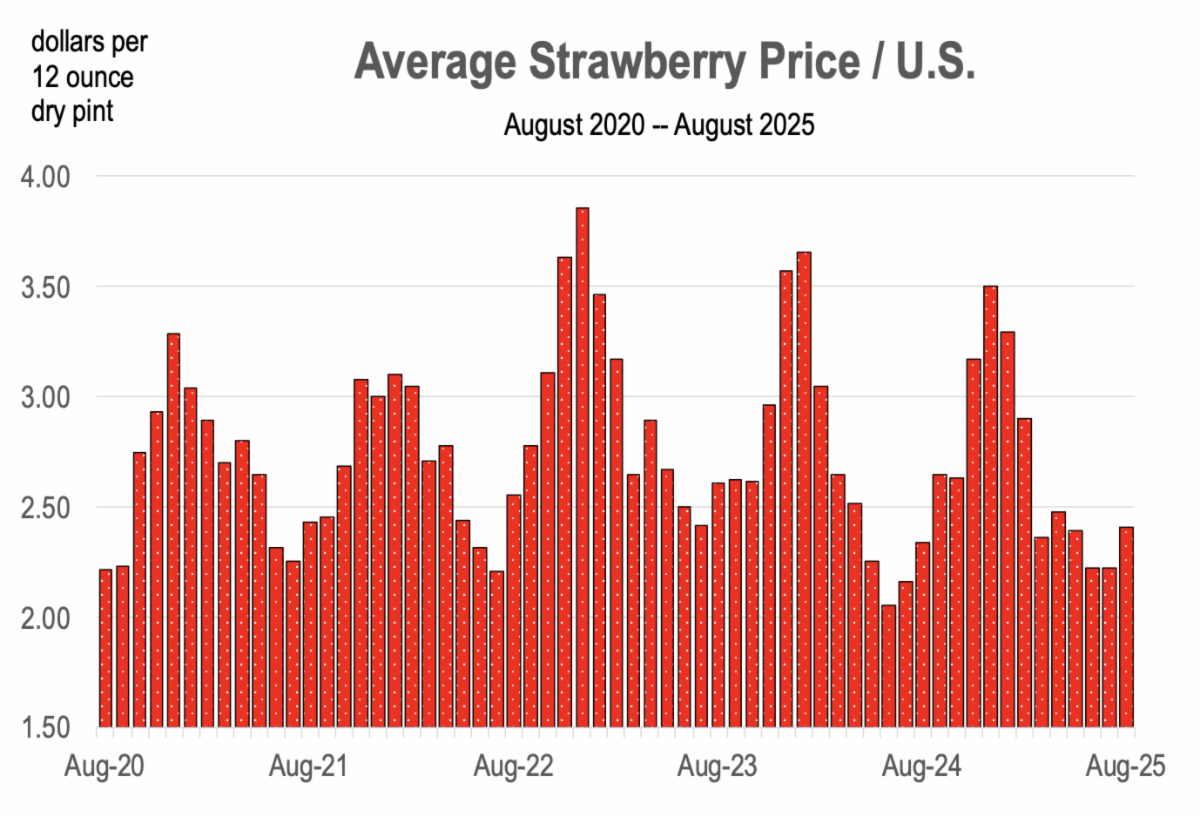
| Farmers are facing numerous challenges impacting operations and profitability. Rising land costs, increasing susceptibility to soil-borne diseases and pests, and labor shortages strain the industry. Environmental factors, including drought and natural disasters, require costly adaptations. Economic pressures from market fluctuations and global competition have resulted in much greater price volatility. These uncertainties, combined with operational challenges, have hampered farming in the region.
The agricultural sector relies heavily on a consistent and skilled workforce for tasks such as planting, maintenance, and harvesting. However, the availability of farm labor has been declining, exacerbated by factors such as limited affordable housing for workers, competition from other industries, and deportations in 2025 of illegal alien workers.
Population
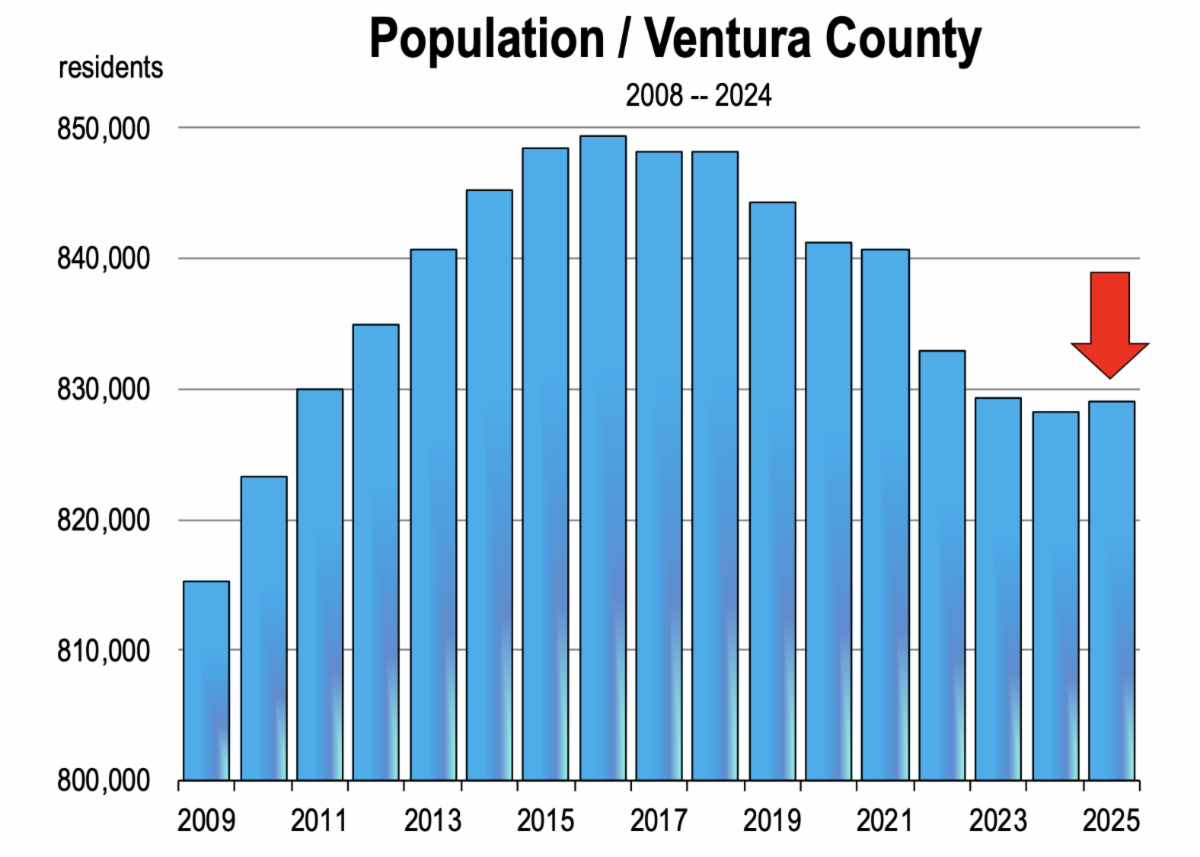
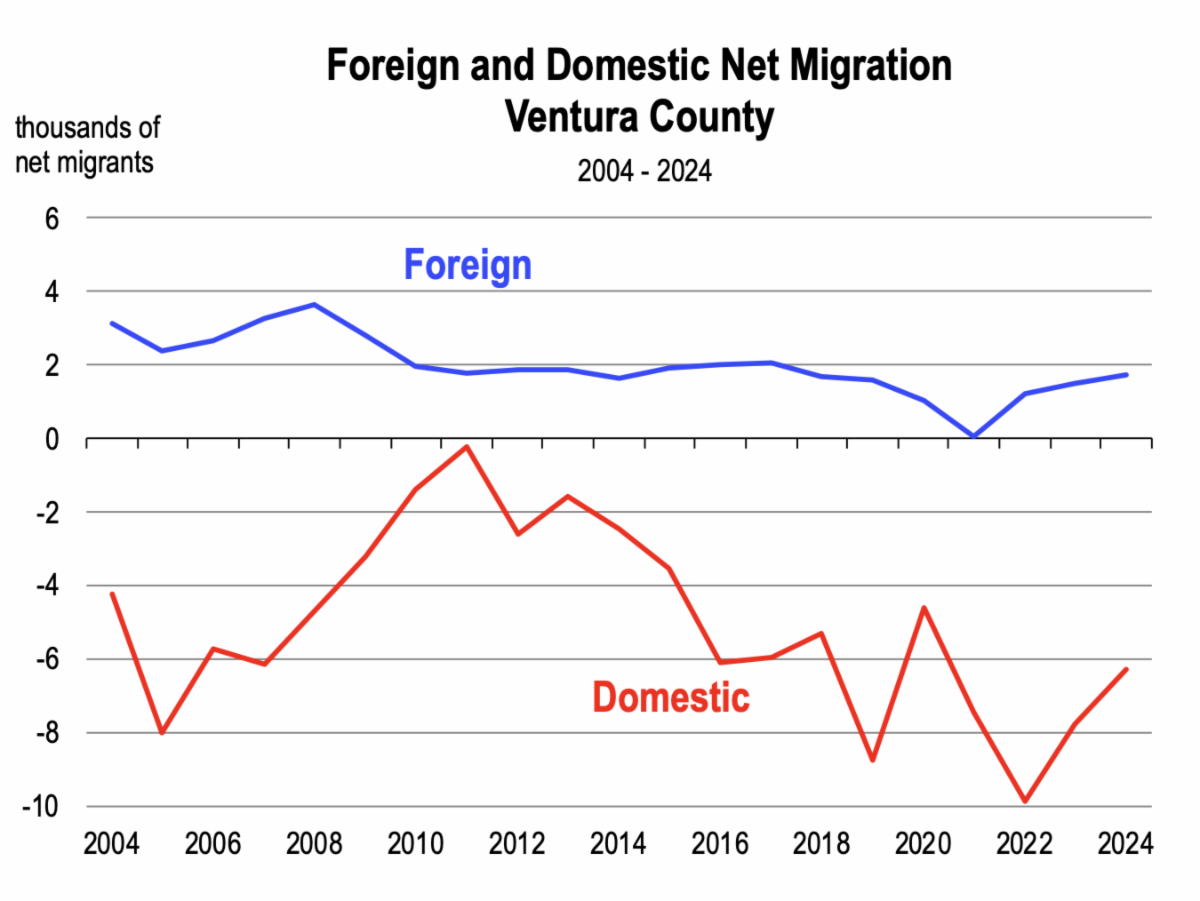
The county’s population had been continuously in decline since 2016, but moved slightly higher in the 2025 estimate reported by the Department of Finance earlier this year. The reversal was entirely due to the highest level of foreign immigration since 2017 combined with fewer residents leaving the county. |
|
| Immigration policy has dramatically changed with the incoming Administration in January of 2025. Foreign immigration has been sharply curtailed at both the northern and southern boarders of the U.S. Consequently, it is likely that a resumption of declining population will extend into 2026 and probably beyond.
Labor Markets
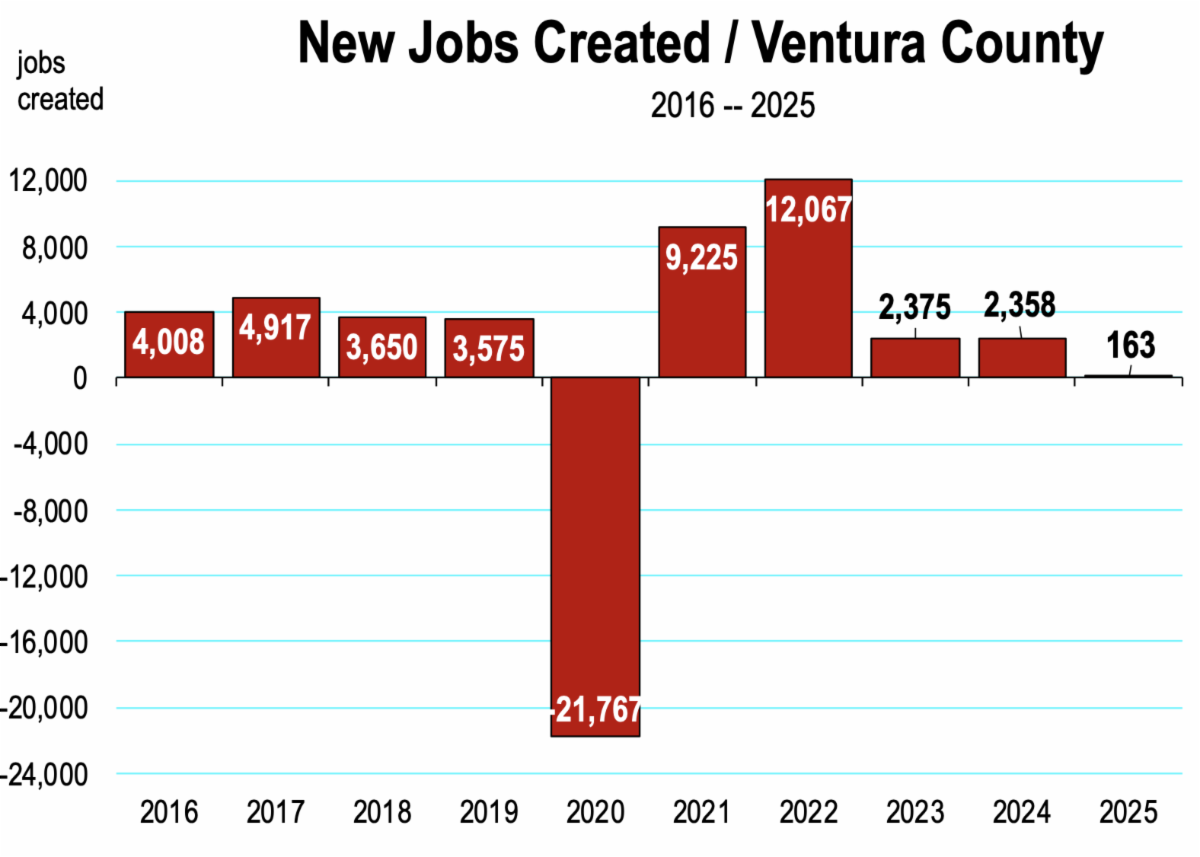
New job formation has largely been absent from California, the SCAG region, and Ventura County in 2025. The current pace of job creation is on pace to add only 163 jobs to total employment for the calendar year. |
|
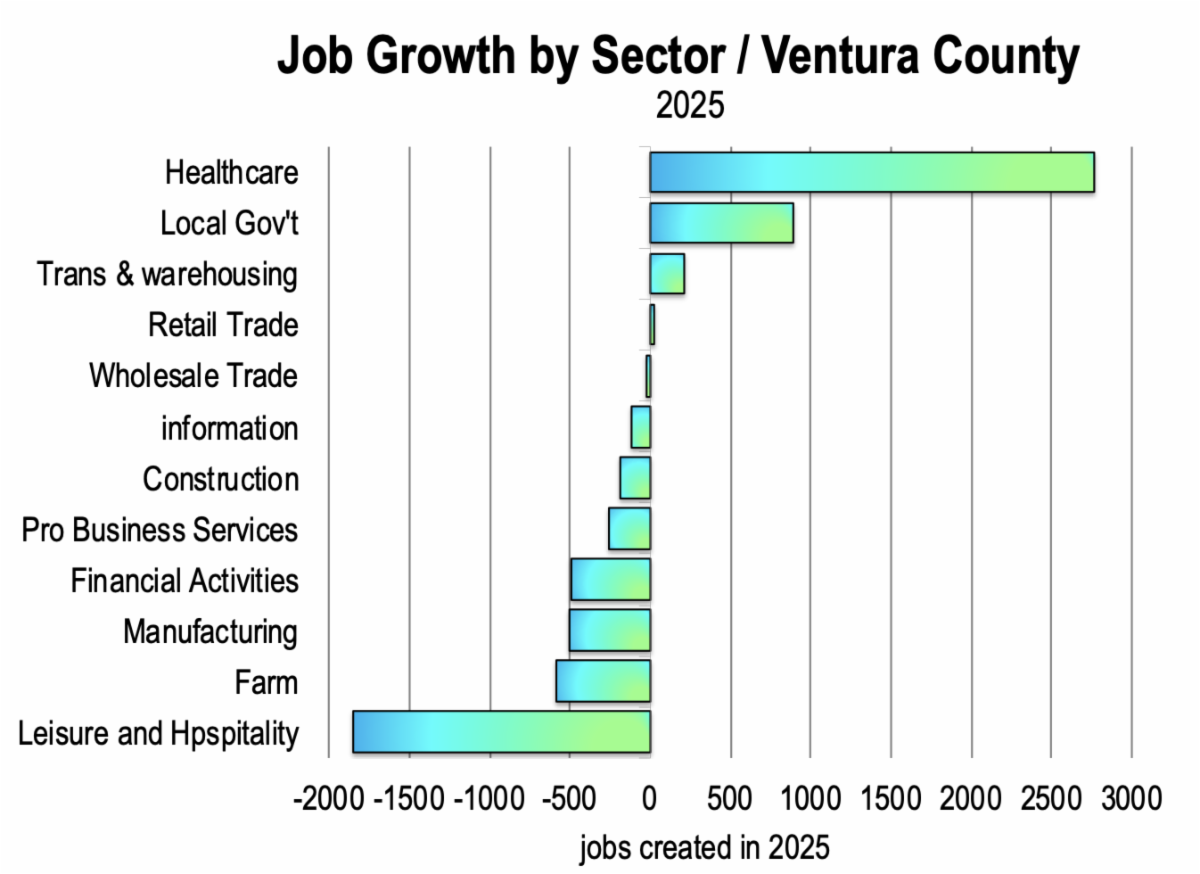
| Healthcare and local government are the only sectors creating meaningful jobs this year. For all other industries, except transportation and warehousing, there has been job attrition.
The creation of jobs by the healthcare and public sector is pervasive across California, In the remaining sectors where workforces have been reduced, wages and salaries have increased due in large part to productivity gains and very little new hiring of entry level positions as the advent of AI has replaced much of that requirement. |
|
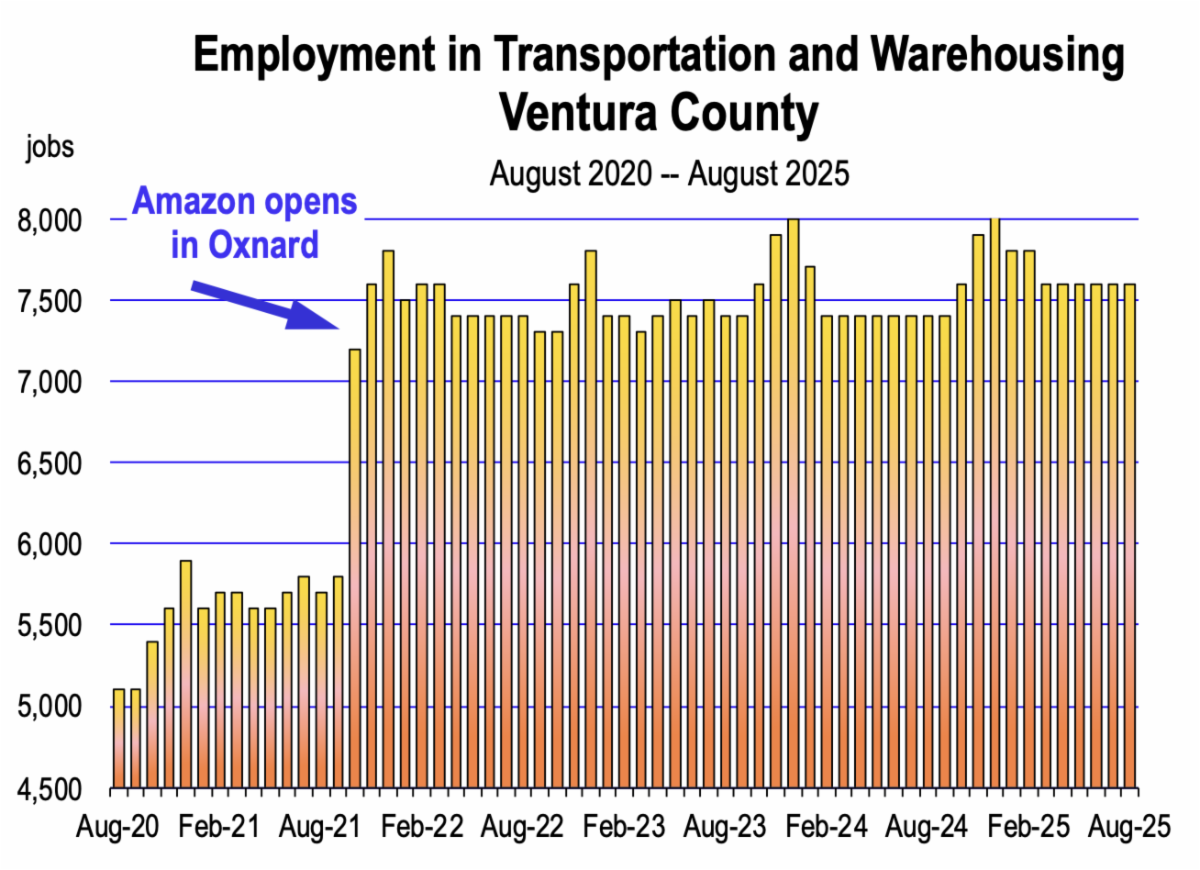
| Logistics has represented a growing influence in the region especially in Orange County and the Inland Empire. More industrial facilities have been built or are underway in Ventura County since the Pandemic. The Amazon facility in Oxnard is a state-of-the-art fulfillment center providing same day service for Prime Members.
Logistics is the only other jobs sector that has added new jobs this year.
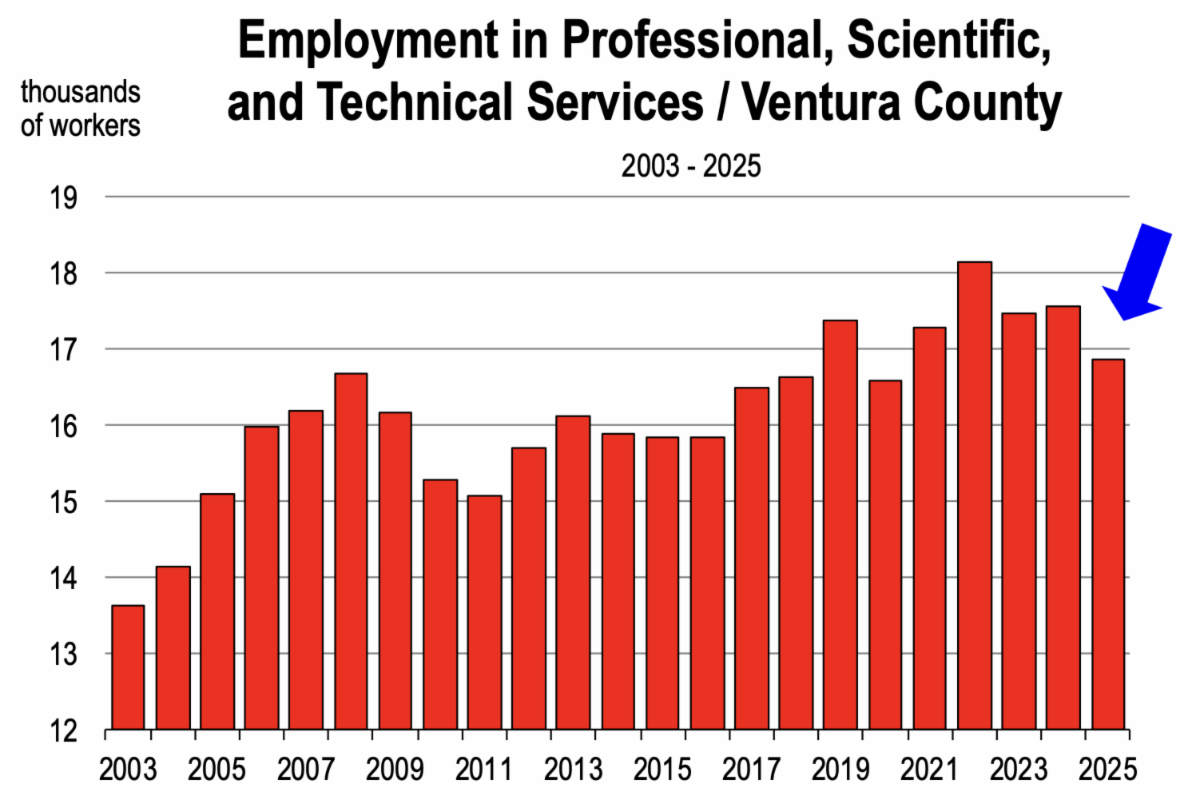
Over one thousand jobs have been lost in the technology sector, here represented by the professional, technical, and scientific consulting sub-sector of Professional Business Services. |
|
| The decline since 2022 has occurred in sync with the trajectory of the same employment sector in California.
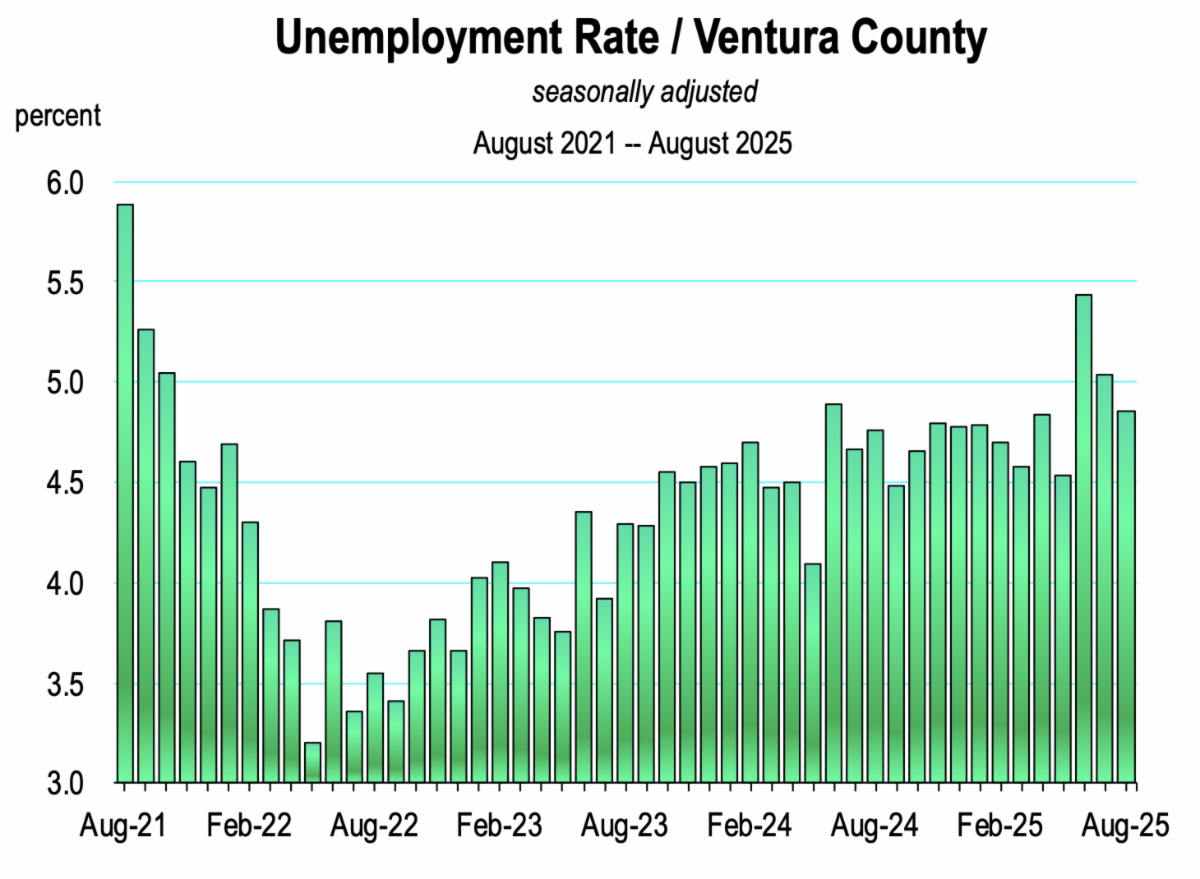
The question of whether the lack of job creation is problematic this year can be addressed in part by the extent to which unemployment has risen. |
|
| Through August, the rate is still less than 5.0 percent. If any trauma does exist, the more aggregate data for California indicates that younger age groups that fill entry level jobs are experiencing serious unemployment. The fill of entry level positions has been meaningfully reduced by industries most exposed to AI, including financial activities, professional business services, and manufacturing. |
|
|
| New Development
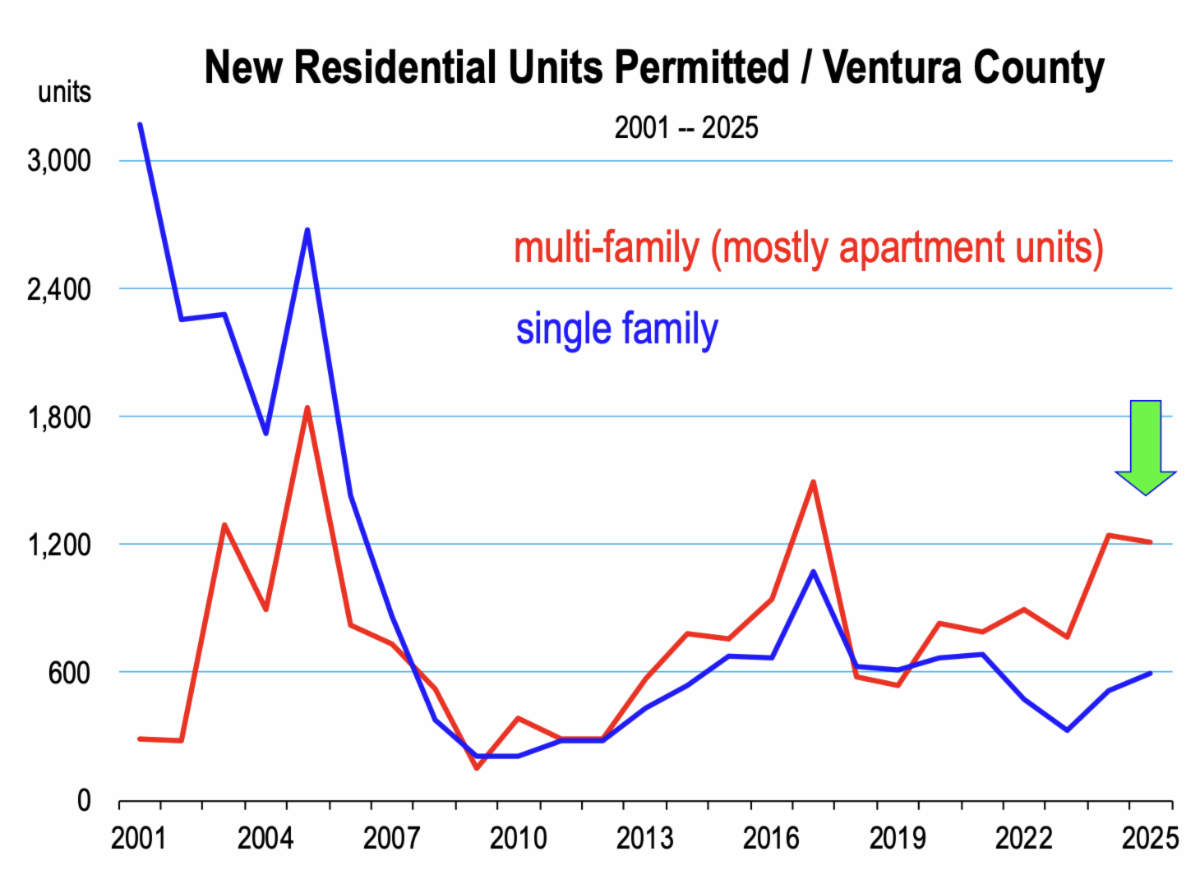
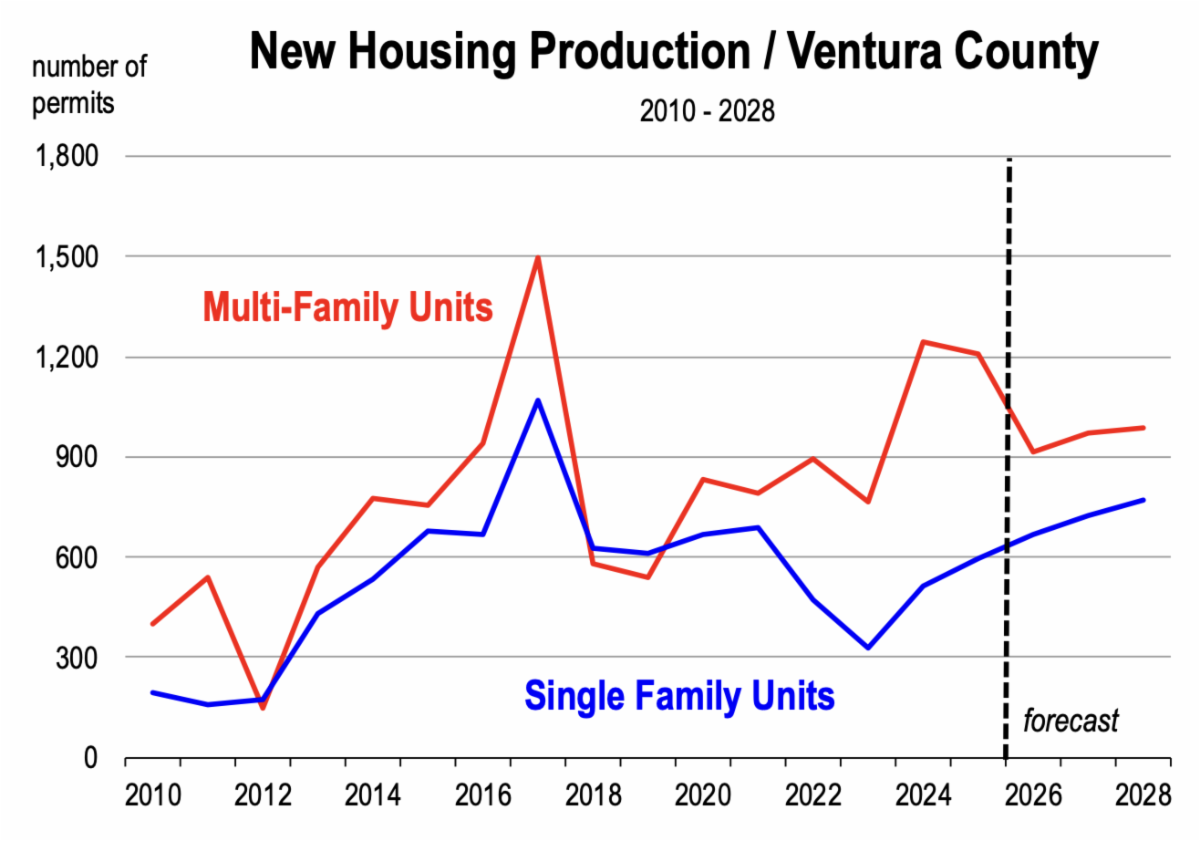
The pace of new residential building has accelerated since 2022. New residential development in 2025 is occurring at the fastest pace since 2017, principally on the surge of new apartment projects that have been permitted. |
|
|
For building through 2024, Oxnard and Camarillo led all 10 cities in new housing starts. In 2025, Oxnard, Camarillo, and Santa Paula have permitted nearly all of the apartment units in the County, which total 729 through July.
Many of the projects that have either broken ground or were approved since 2022 have been legacy projects lingering in the building entitlement process for years.
New development of non-residential structures and/or projects was weak in 2024, continuing a trend of lower investment levels since 2020. While the number of projects in the pipeline has increased in recent years, few are under construction. By mid 2025, only 100,000 square feet of industrial and 122,000 square feet of retail space was underway.
Real Wages/Salaries and Household Income
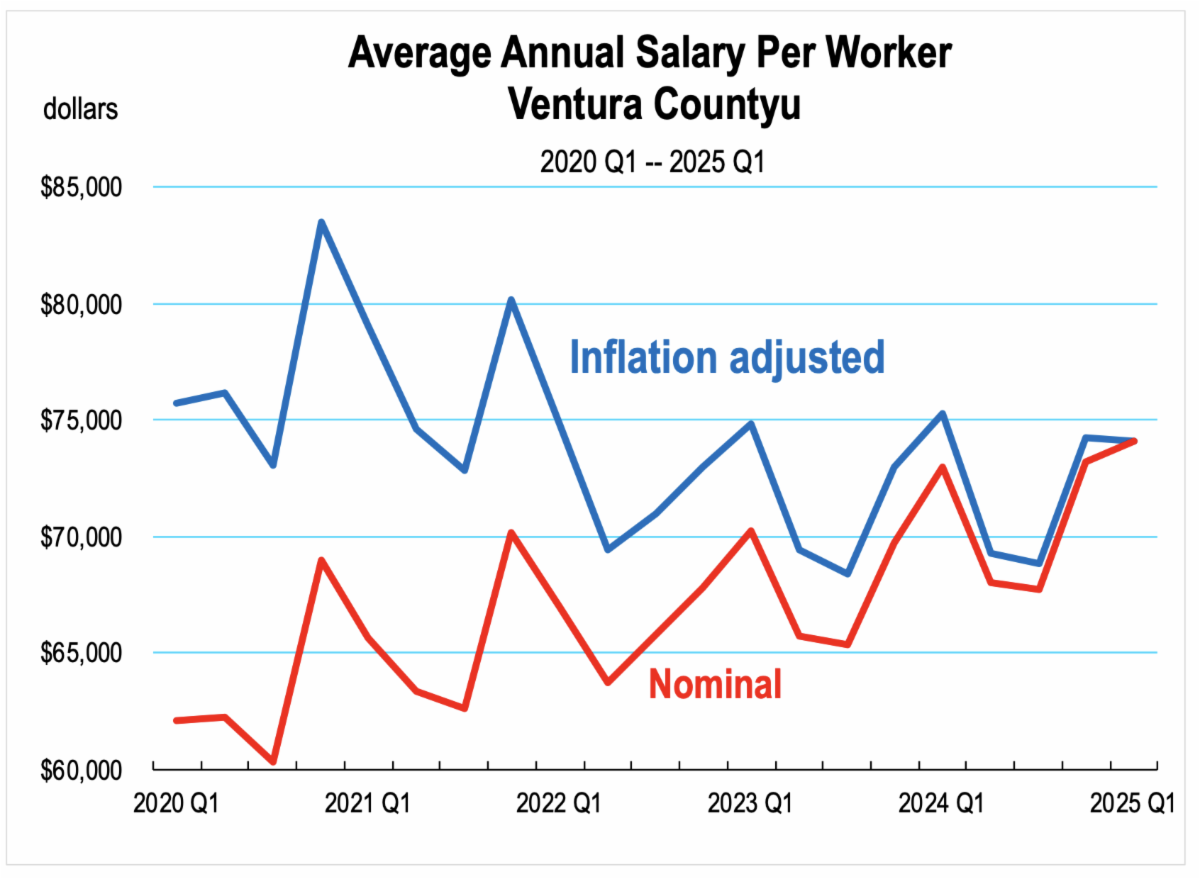
Average wages/salaries have been rising steadily in Ventura County since 2013. Adjusted for inflation however, wages have moved slightly downward since early 2021. Real wages in 2025 Q1 have now declined to the lowest level in seven years. |
|
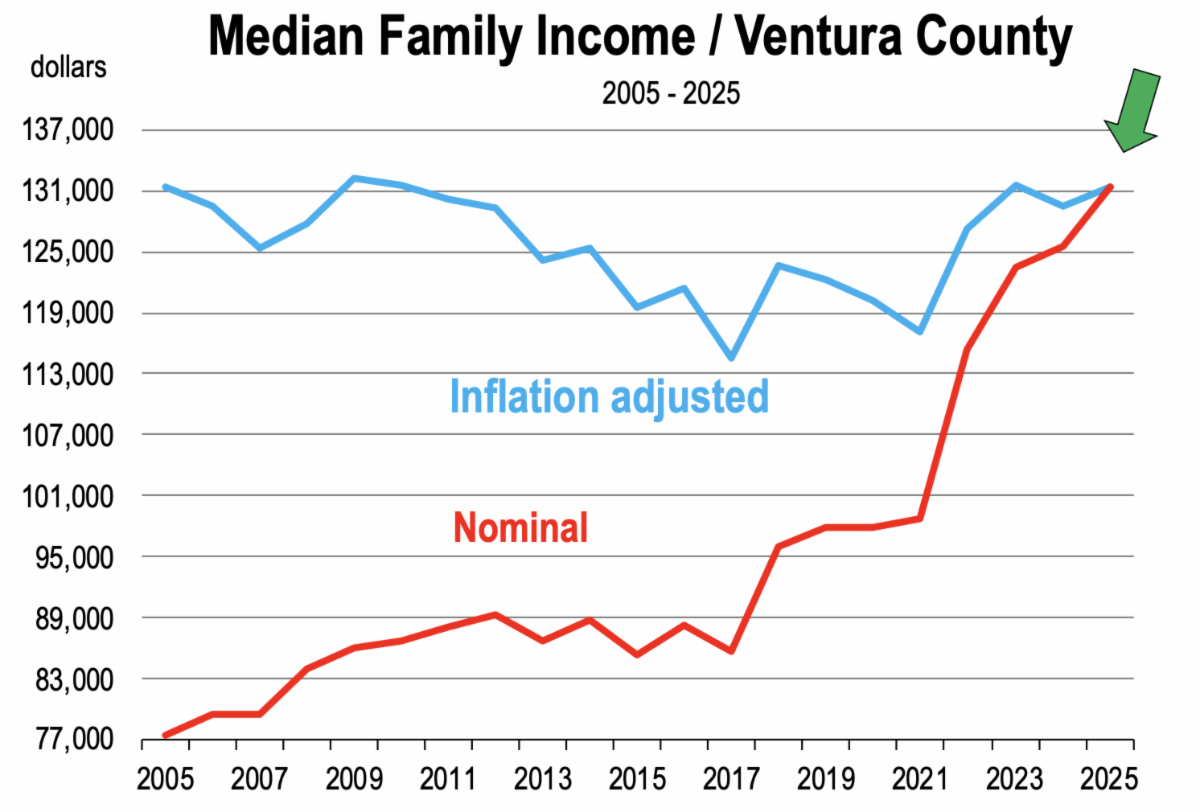
| Though average wages or salaries have not gained any ground since 2018, median household incomes adjusted for inflation have moved higher since 2017 and have restored their purchasing power to 2010 levels. |
|
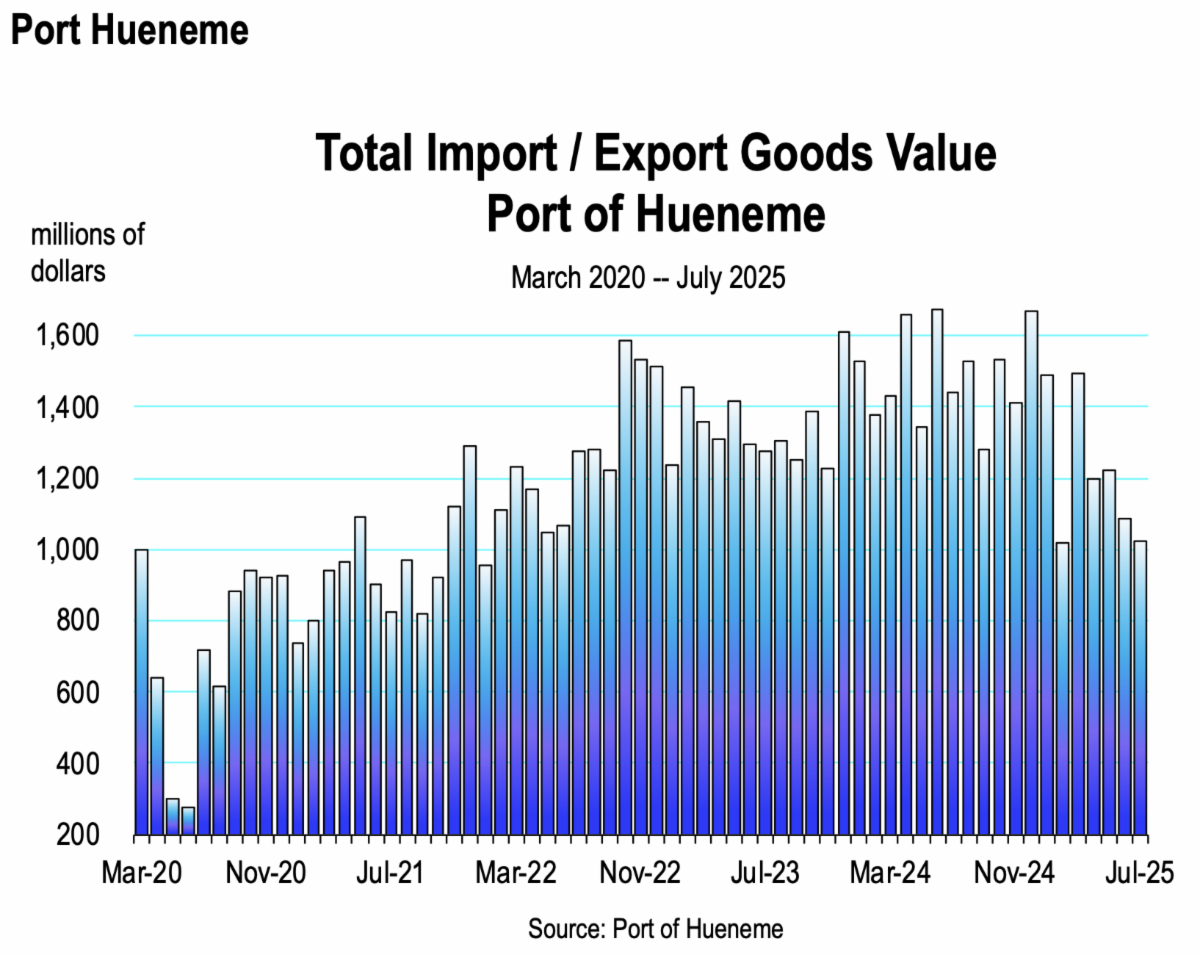
| Following five consecutive years of annual record setting cargo values, imports have slipped in 2025. Tariff rates on automobiles are principally responsible for the decline in imports which comprise 90 percent of all cargo volume. For the first 8 months of 2025, the total volume of imports has declined 21 percent, compared to the same time period in 2024.
Export values have increased sharply in 2025, rising 37 percent over 2024 through August.
The Ports principals import products—-Autos, electric batteries and bananas—will likely regain quantities in 2026 when trade policy is expected to stabilize and the tariff hysteria of 2025 will have subsided.
Consumer spending in the region
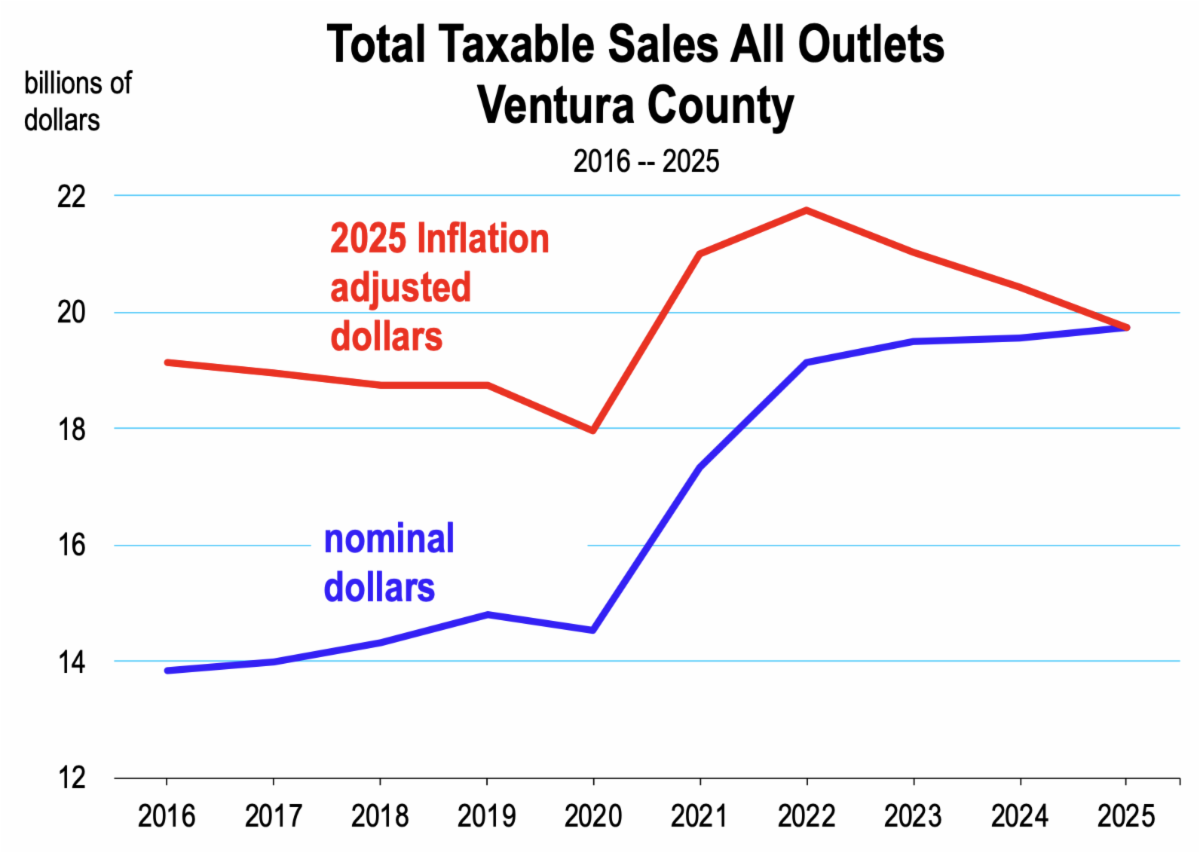
The lack of real wage increases in the county along with sluggish growth of real household incomes has contributed to the weak evidence on retail and total taxable spending in the region. Retail spending is a proxy for consumer spending behavior in the region because it tracks sales at all local outlets located in the region. |
|
|
Real spending for all taxable sales declined 2.9 percent in 2024 and is on pace to fall 3.4 percent in 2025. In recent years, consumers have substituted spending on services for goods which are mostly taxed, and which provide us the data presented here. But the decline in local spending at retail outlets goes beyond simply the transition to more spending on vacations, entertainment, and recreation. Borrowing costs have risen over the time that retail spending has subsided. Labor market employment expansion has cooled over the same time period, together with rising home prices or rental housing rents that have squeezed household budgets.
The observed decline in real spending has moved in tandem with other dubious factors indicative of the regional economy. But the extent of the contraction in real spending has not been pervasive enough to generate a rising sense of economic anxiety in California or its principal regions, including SCAG.
As inflation reduction continues to make progress in 2026 towards the FED target and as real wages continue to generally rise in the region, it is likely that retail spending will rebound next year. The UCLA Anderson Forecast for California has total retail sales in California reversing with positive rates of growth in 2026 and 2027. |
|
|
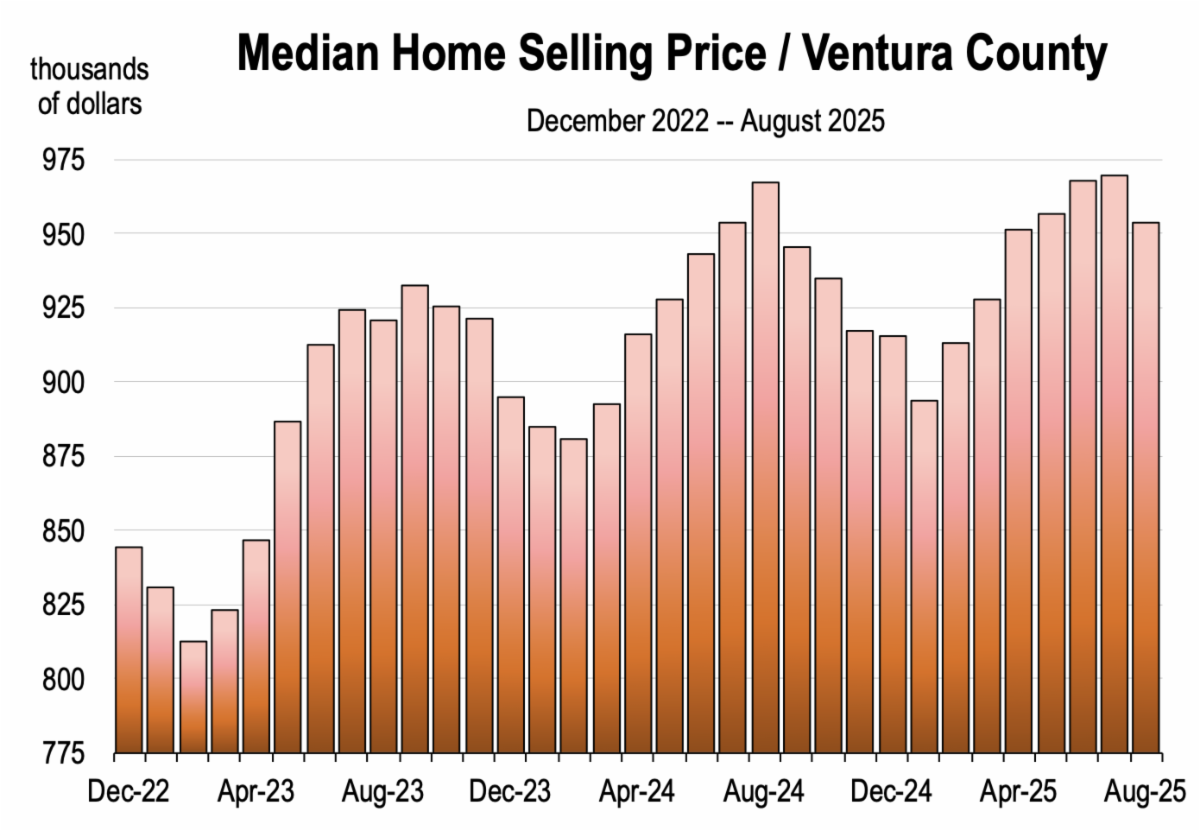
For the first 8 months of 2025, the median selling price of all homes sold was $947,000, a one percent increase over 2024. Sales are also one percent higher this year, but remain, nevertheless, at recession level lows.
With longer term rates falling, more inventory has entered the market by sellers who’ve been reluctant to sell their homes. Inventory is currently up 43 percent in Ventura County during the first 8 months of 2025 compared to 2024. |
|
| The Rental Market
Since 2020, 3,200 apartment units have been completed in Ventura County. Just last year, 1,373 apartment units were delivered to the market.
SOAR has forced more compact development in Ventura County’s cities. And compact development means higher housing densities. Also, rising home prices have eliminated many households from ownership housing. Consequently, a growing proportion of the population is now renting.
With the delivery of so much new product, the vacancy rate for apartment units had climbed to 5 percent in early 2025 from a year ago. But over the first half of 2025, demand has caught up with supply and vacancy rates have now retreated again to 3.6 percent. Rental price inflation has also dropped to less than 2 percent this year. With more, new apartment product scheduled to be completed, rental price appreciation rates are not expected to change much.
The Outlook for Ventura County
Modest growth of the County’s economy has occurred in the aftermath of the pandemic. The regional economy is creating jobs but has struggled to generate net positive economic growth over the last 3 years, and even longer. There is very little evidence of accelerating momentum in any particular sector. Even import trade volumes through the Port of Hueneme have meaningfully declined this year due to international trade policy.
The only population age group that is rising in Ventura County is the 65-year-old and above cohort. Though it is these older households that can more likely assimilate housing, they are not adding to the labor force, and their consumption spending is much less than younger age households.
Real consumer spending on taxable goods within retail stores and other outlets in Ventura County was lower in 2024 and 2025. A leveling off in 2026 is projected and a rebound in spending is probably in 2027 but no windfall changes characterize the forecast.
Job growth had been positive in Ventura County since the pandemic, but the lack of broad-based participation by the labor market has been concerning. Only three sectors have created jobs. Over the forecast, employment growth does remain positive, but at rates of less than 0.5 percent per year. |
|
|
Oxnard and Camarillo are the locations of more new housing in the region. The type of housing being built today is principally apartment projects. Moorpark will likely contribute largely to new housing as Hitch Ranch starts up next year. Together with North Ranch, more single family detached housing will be built, which should attract family households of working age if job opportunities emerge.
More new housing is in the forecast for the next several years but most of it is higher density multi-family projects that will provide homes to younger households.
Existing home sales pick up in 2026 with the gradual expansion of inventory and long term interest rates that modestly contract. Home selling values are still forecast to rise but only at the rate of general price inflation. |
|
| Written by Dr. Mark Schniepp
Dr. Mark Schniepp is a VCTF Board Member and Economic Advisor. Dr. Schniepp is currently Director of the California Economic Forecast in Santa Barbara. The Company prepares forecasts and commentary on the regional economies of California. |
|
|
About the Ventura County Taxpayers Foundation
The Ventura County Taxpayer’s Foundation (VCTF) is a non-partisan 501(C)(3) organization emphasizing issues that affect Ventura County. Empowering Taxpayers, Building Trust, and Safeguarding Resources.
Ventura County Taxpayers Foundation
PO Box 3878
Ventura, CA 93006
www.vctax.org
|
|
|
|
|