
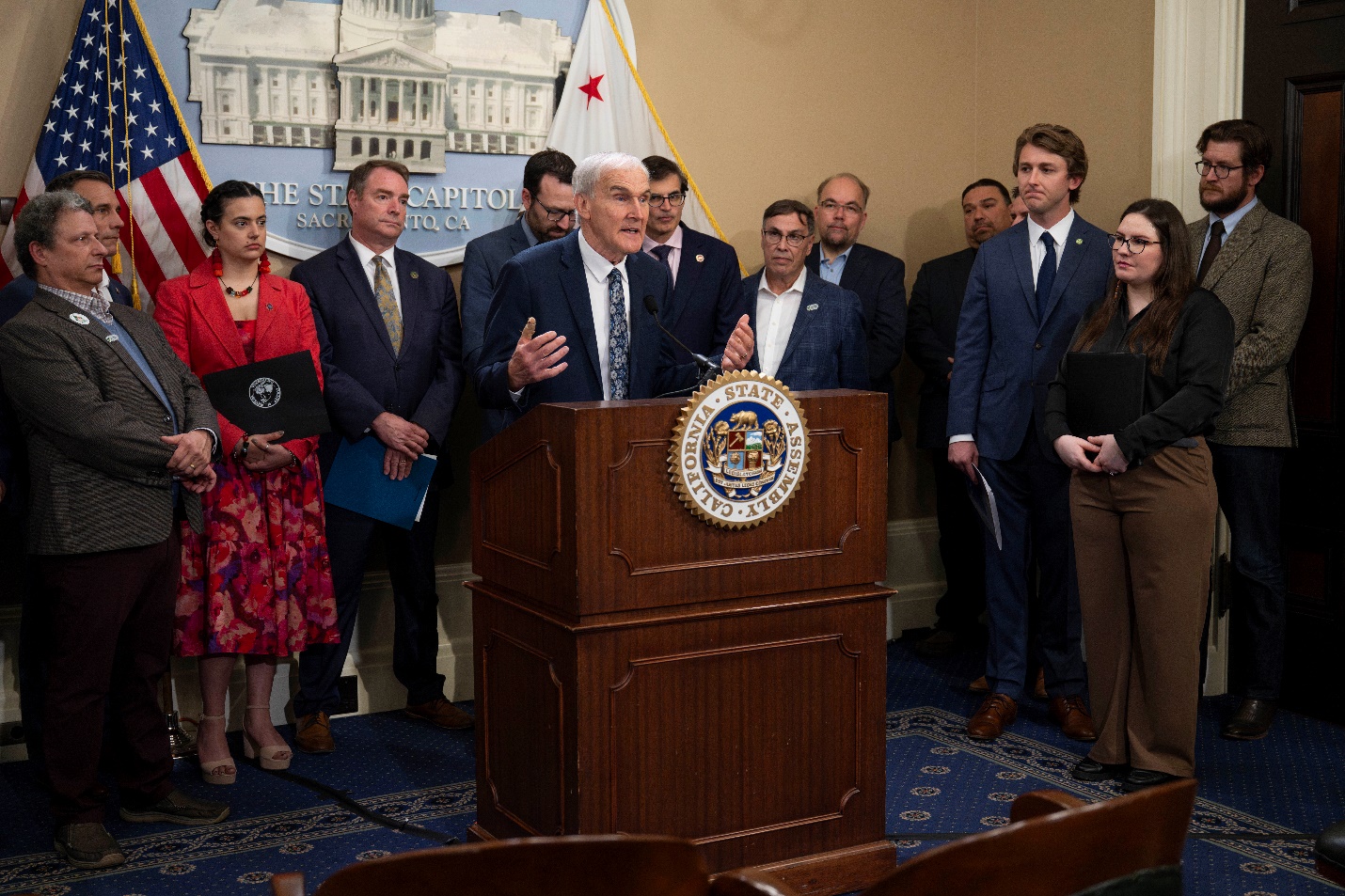
Photo Courtesy: Assembly Democratic Caucus — Photographer Krishnia Parker.
More than a dozen bills across the Senate and Assembly will advance home hardening, expand beneficial fire, unlock financing, and accelerate innovation to better protect California from future megafires
“For years, we have worked on cultivating an enhanced sense of urgency in how Sacramento discusses wildfire prevention in the built environment,” said Assemblymember Steve Bennett (D- Ventura) “We are committed to establishing policies based on proven methods that reduce loss of life and property so that our communities have a greater chance of surviving fast-moving blazes. I’m proud to partner with my legislative colleagues on crafting a bill package that centers on community resilience and is informed by firsthand experience.”
Assemblymember Bennett’s six bills represent one of the most significant legislative efforts aimed at reducing risk in the built environment—aligning certification, incentives, insurance transparency, tax policy, and community-level preparedness to make home and neighborhood hardening the norm rather than the exception.
SACRAMENTO — More than a dozen bills were highlighted on March 4 as part of the 2026 “Joint Megafire Prevention Package.” Senators Allen, Becker and Stern, alongside Assemblymembers Bennett, Connolly and Rogers, have introduced the most comprehensive package aimed at mitigating destructive wildfires in the state’s history. Leading wildfire organizations including Megafire Action, FireWERX, California Fire Safe Council, and the Karuk Tribe stood alongside the legislators.
The bill package, which includes legislation spanning home hardening, resilience loan financing, expansion of existing fire mitigation programs, support for and reducing barriers to beneficial fire, and more, is a priority for fire mitigation advocates following the deadly 2025 megafires in Los Angeles.
“Families across California are grappling with the reality of a drier, hotter climate that is driving more frequent and more ferocious fires,” said Senator Ben Allen (D-Pacific Palisades), author of SB 894. “This increased climate risk is leaving communities with fewer insurance options and higher premiums, putting the dream of homeownership out of reach for too many Californians. Using strategic financing, smarter planning, and new technologies, we can tangibly reduce fire risk, protect more properties and communities, and save lives.”
“As wildfires become year-round, more intense, destructive, and deadly, California must act with urgency and coordination,” said Senator Josh Becker (D-Menlo Park). “SB 973 creates a statewide framework to strengthen community wildfire resilience by directing CAL FIRE to develop guidance and recommended standards for local entities assessing wildfire risk and prioritizing wildfire mitigation activities, and to expand the Wildfire County Coordinator Program. This bill moves us from reactive to proactive, giving communities the resources and coordination they need before disaster strikes. We can’t control when the next fire ignites, but we can control how prepared we are.”
“By strengthening county capacity, SB 973 ensures California’s wildfire investments deliver real risk reduction where it matters most—on the ground, in high-risk communities,” said Jacy Hyde, PhD, Executive Director of the California Fire Safe Council.
SB 973 will build upon the successful Wildfire County Coordinator Program to provide critical resources needed to accelerate wildfire mitigation in communities.
“Megafires are burning down California, driving up utility and insurance bills in the process,” said Senator Henry Stern (D – Los Angeles). “We can only prevent these tragedies and cut these costs if we reduce risks through a more efficient, innovative, community scaled approach.”
“Wildfires are growing in intensity and severity, and if we continue doing things the way we always have, we should expect the same devastating outcomes,” said Chris Anthony, Founder and CEO of FireWERX. “Senator Stern’s Fire Innovation Unit Act creates a formal pathway to identify real operational needs, co-develop solutions with firefighters, rigorously evaluate them, and move the best tools from pilot to statewide deployment.”
Building on Governor Newsom’s leadership in providing cutting-edge technologies to frontline personnel, SB 1079 would create a new Fire Innovation Unit (FIU) within CAL FIRE to give California a formal mechanism to identify firefighter needs, source technologies, prototype solutions, and move successful technologies from pilot to scale across three programs
“Beneficial fire has been a proven practice utilized by California’s first peoples for thousands of years,” said Assemblymember Damon Connolly (D-San Rafael). “It is an honor to stand with the Karuk Tribe and the Watershed Research and Training Center to introduce AB 1891 to dedicate grant funding to beneficial fire practitioners. The evidence is clear, beneficial fire projects help our ecosystems foster biodiversity, reduces wildfire risk, and preserves natural habitats and forests. It is time we expand these practices and give California another tool to help make our state more resilient to wildfires and natural disasters.”
AB 1891 (Connolly) and AB 1699 (Rogers) work together to expand the pace and scale of beneficial fire in California by investing in local and tribal capacity while removing liability and permitting barriers that have slowed prescribed and cultural burns. Critically, both measures recognize the essential role of California Tribes in stewarding fire-adapted landscapes and ensure they have the authority and resources to lead.
“Planning for wildfires isn’t a luxury, it’s a necessity. I’m proud to stand with other legislators that prioritize keeping Californians safe by taking steps to prevent or curb fires from ravaging our communities,” said Assemblymember Chris Rogers (D-Santa Rosa)
“Indigenous people have been burning since Time Immemorial to manage our homelands. Fire promotes the cultural and ecological resources we need to thrive, and it protects our communities and landscapes from catastrophic wildfire. We appreciate that California legislators are looking at wildfire mitigation in a comprehensive way, recognizing that both landscape resilience and the built environment are critical to address, and humans have a central role in stewarding all of it, with beneficial fire as one of our most essential tools. We are excited to sponsor Assemblymember Connolly’s AB 1891 and support Assemblymember Roger’s AB 1699 which both support increasing the pace and scale of beneficial fire in California” said Karuk Tribe Vice Chairman Kenneth Brink.
“We honor the victims of the Los Angeles wildfires not only by helping communities rebuild, but by making government work better before disaster strikes,” said Eric Horne, California Director of Megafire Action. “The Joint Megafire Prevention Package represents one of the most comprehensive wildfire mitigation efforts in recent years and will help restore resilience to our landscapes, provide homeowners with clear guidance and resources to reduce risk, and accelerate the adoption of new technologies that give firefighters and communities better tools to protect lives and property. We applaud the members who are championing this issue and look forward to partnering together in coming weeks and months to protect Californians.”
The bills highlighted as part of the Wildfire Prevention Package include:
- SB 894 (Allen): Wildfire Mitigation Affordability Act
- SB 973 (Becker): Wildfire County Coordinator Program
- SB 911 (Becker): Transfer of real property: compliance documentation
- SB 1079 (Stern): Fire Innovation Unit Act
- SB 1404 (Stern): Wildfire and Forest Resilience Action Plan: Implementation Strategy
- AB 1699 (Rogers): Good Fire Act
- AB 1891 (Connolly): Beneficial Fire Capacity Program
- AB 1934 (Bennett): Home Hardening Certification Program
- AB 1960 (Bennett): Wildfire Prevention Grants Program
- AB 1964 (Bennett): County Recorder: Home Hardening
- AB 1971 (Bennett): Home Hardening Retrofitting Improvements
- AB 1986 (Bennett): Residential Property Insurance – Home Hardening
- AB 2013 (Bennett): Water Suppliers – Emergency Preparedness Program
— Steve Bennett represents the 38th Assembly District, which includes Camarillo, Fillmore, Ojai, Oxnard, Port Hueneme, Santa Paula, and Ventura. He is chair of the Budget Subcommittee No. 4 on Climate Change, Natural Resources, and Transportation.